
Welcome to the Tracefossils subsite on Invertebrate Paleontology!
Please enter a genera name to retrieve more information.
Arenicolites
Classification
Phylum:
Trace Fossils and Problematica
Class:
Trace Fossils
Formal Genus Name and Reference:
Arenicolites SALTER, 1857, p. 204
Type Species:
*Arenicola carbonaria Binney, 1852, p. 192, SD Richter, 1924, p. 137, second SD (rejecting Richter's designation) by Bather, 1925, p. 198: Arenicolites didymus Salter, 1857, p. 200 (=Arenicola didyma SALTER, 1856, p. 248)
Images
(Click to enlarge in a new window)
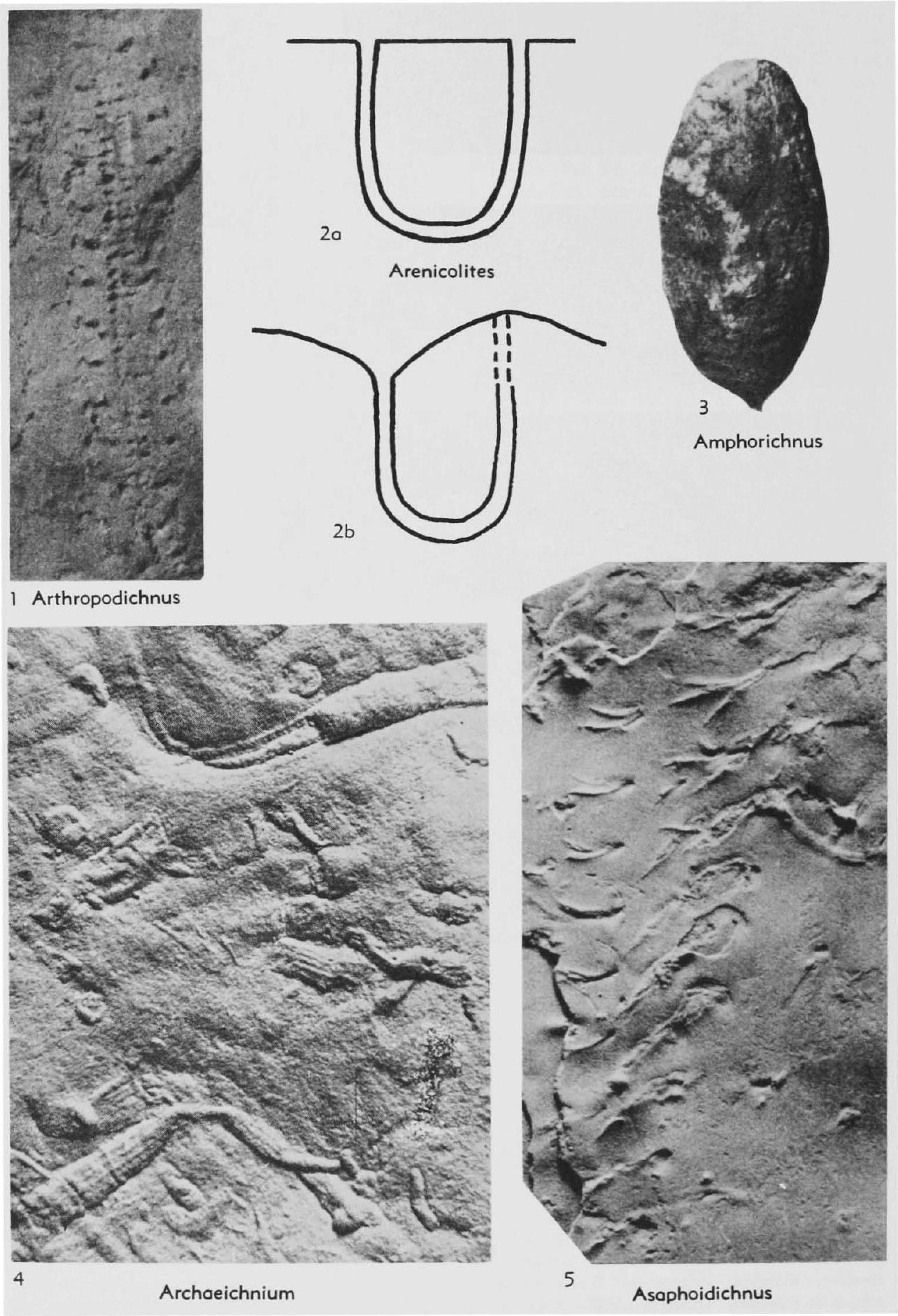 Fig. 24,2a. A. sp. SALTER; schematic (Trusheim, 1934). -- Fig. 24, 2b. A. franconicus TRUSHEIM, M.Trias., Ger.; schem. cross sec. of burrow, X0.8 (Trusheim, 1934)
Synonyms
Arenicolithes
Geographic Distribution
Eu.-USA-Greenl. [Probably worldwide.
Age Range
Beginning Stage in Treatise Usage:
Cam.
Beginning International Stage:
Fortunian
Fraction Up In Beginning Stage:
0
Beginning Date:
538.8
Ending Stage in Treatise Usage:
U.Cret.
Ending International Stage:
Maastrichtian
Fraction Up In Ending Stage:
100
Ending Date:
66.04
Description
Simple U-tubes without spreite, perpendicular to bedding plane, varying in size, tube diameter, distance of limbs, and depth of burrows, limbs rarely somewhat branched, some with funnel-shaped opening, walls commonly smooth, occasionally lined or sculptured, burrows may reach considerable depth. [Certainly made by worms or wormlike animals; in places widely distributed; TRUSHEIM (1934) described, from German Middle Triassic Muschelkalk, Arenicolites franconicus marker-bed, only 2 to 5 em. thick, which has observed lateral extent of about 25 kilometers.] [Several species should not be placed in genus, e.g., A. didyma SALTER. seems to be resting trace of the Rusophycus type; A. spiralis TOI.ELL, 1868, is type species of Spiraleolex TORELL, 1870; A. lunaeformis KOLESCH, 1922, A. zimmermanni KOUSCH, 1922, A. stather; BATHER., 1925, and A.? lymensis BIGOT. 1941, are U-shaped burrows with spreite.]
References
Museum or Author Information
Classification
Phylum:
Trace Fossils and Problematica
Class:
Trace Fossils
Formal Genus Name and Reference:
Arenicolites SALTER, 1857, p. 204
Type Species:
*Arenicola carbonaria Binney, 1852, p. 192, SD Richter, 1924, p. 137, second SD (rejecting Richter's designation) by Bather, 1925, p. 198: Arenicolites didymus Salter, 1857, p. 200 (=Arenicola didyma SALTER, 1856, p. 248)
Images
(Click to enlarge in a new window)
Fig. 24,2a. A. sp. SALTER; schematic (Trusheim, 1934). -- Fig. 24, 2b. A. franconicus TRUSHEIM, M.Trias., Ger.; schem. cross sec. of burrow, X0.8 (Trusheim, 1934)
Synonyms
Arenicolithes
Geographic Distribution
Eu.-USA-Greenl. [Probably worldwide.
Age Range
Beginning Stage in Treatise Usage:
Cam.
Beginning International Stage:
Fortunian
Fraction Up In Beginning Stage:
0
Beginning Date:
538.8
Ending Stage in Treatise Usage:
U.Cret.
Ending International Stage:
Maastrichtian
Fraction Up In Ending Stage:
100
Ending Date:
66.04
Description
Simple U-tubes without spreite, perpendicular to bedding plane, varying in size, tube diameter, distance of limbs, and depth of burrows, limbs rarely somewhat branched, some with funnel-shaped opening, walls commonly smooth, occasionally lined or sculptured, burrows may reach considerable depth. [Certainly made by worms or wormlike animals; in places widely distributed; TRUSHEIM (1934) described, from German Middle Triassic Muschelkalk, Arenicolites franconicus marker-bed, only 2 to 5 em. thick, which has observed lateral extent of about 25 kilometers.] [Several species should not be placed in genus, e.g., A. didyma SALTER. seems to be resting trace of the Rusophycus type; A. spiralis TOI.ELL, 1868, is type species of Spiraleolex TORELL, 1870; A. lunaeformis KOLESCH, 1922, A. zimmermanni KOUSCH, 1922, A. stather; BATHER., 1925, and A.? lymensis BIGOT. 1941, are U-shaped burrows with spreite.]