
Welcome to the Tracefossils subsite on Invertebrate Paleontology!
Please enter a genera name to retrieve more information.
Asterosoma
Classification
Phylum:
Trace Fossils and Problematica
Class:
Trace Fossils
Formal Genus Name and Reference:
Asterosoma von OTTO, 1854, p. 15
Type Species:
* A. radiciforme, M
Images
(Click to enlarge in a new window)
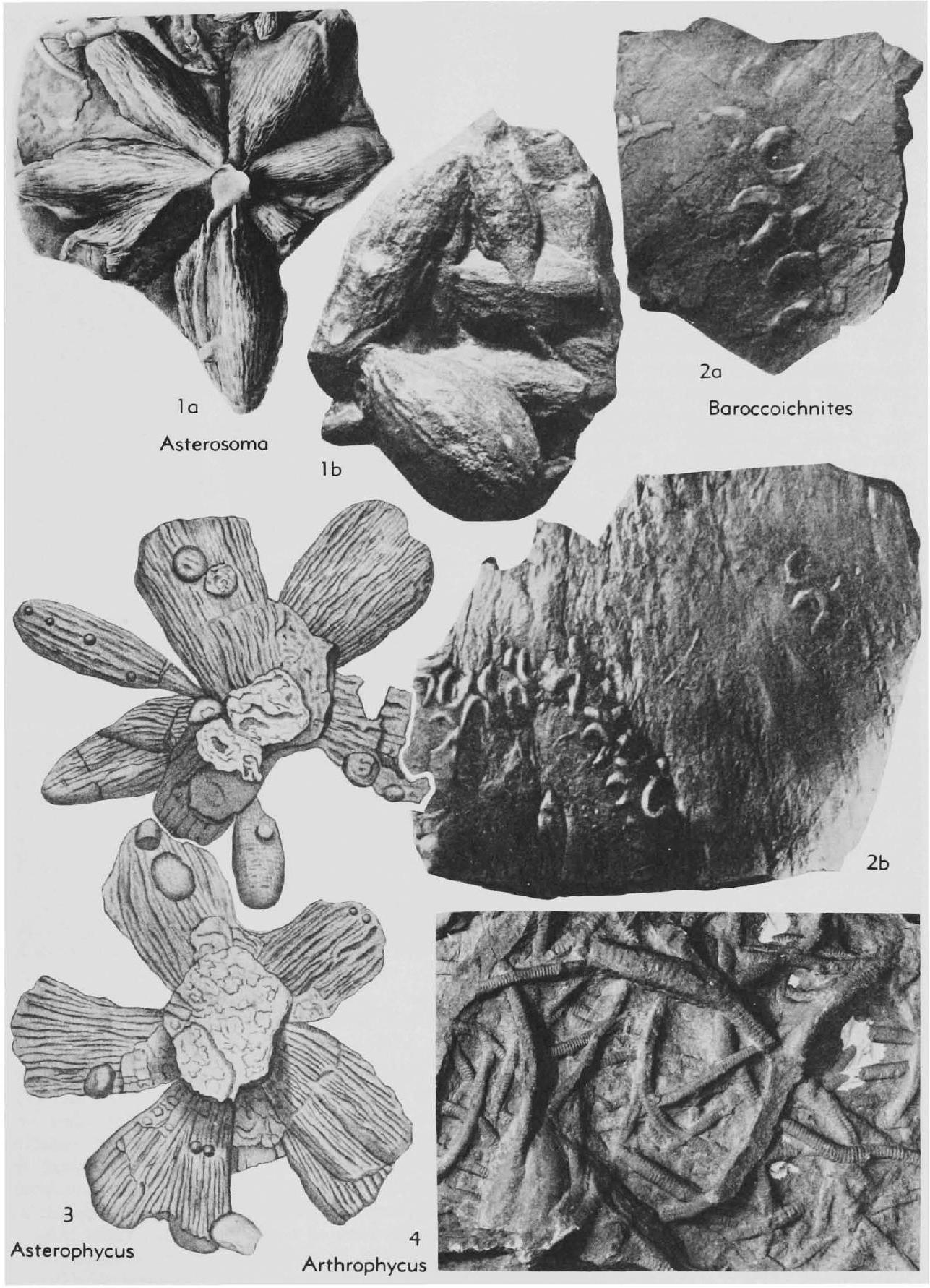
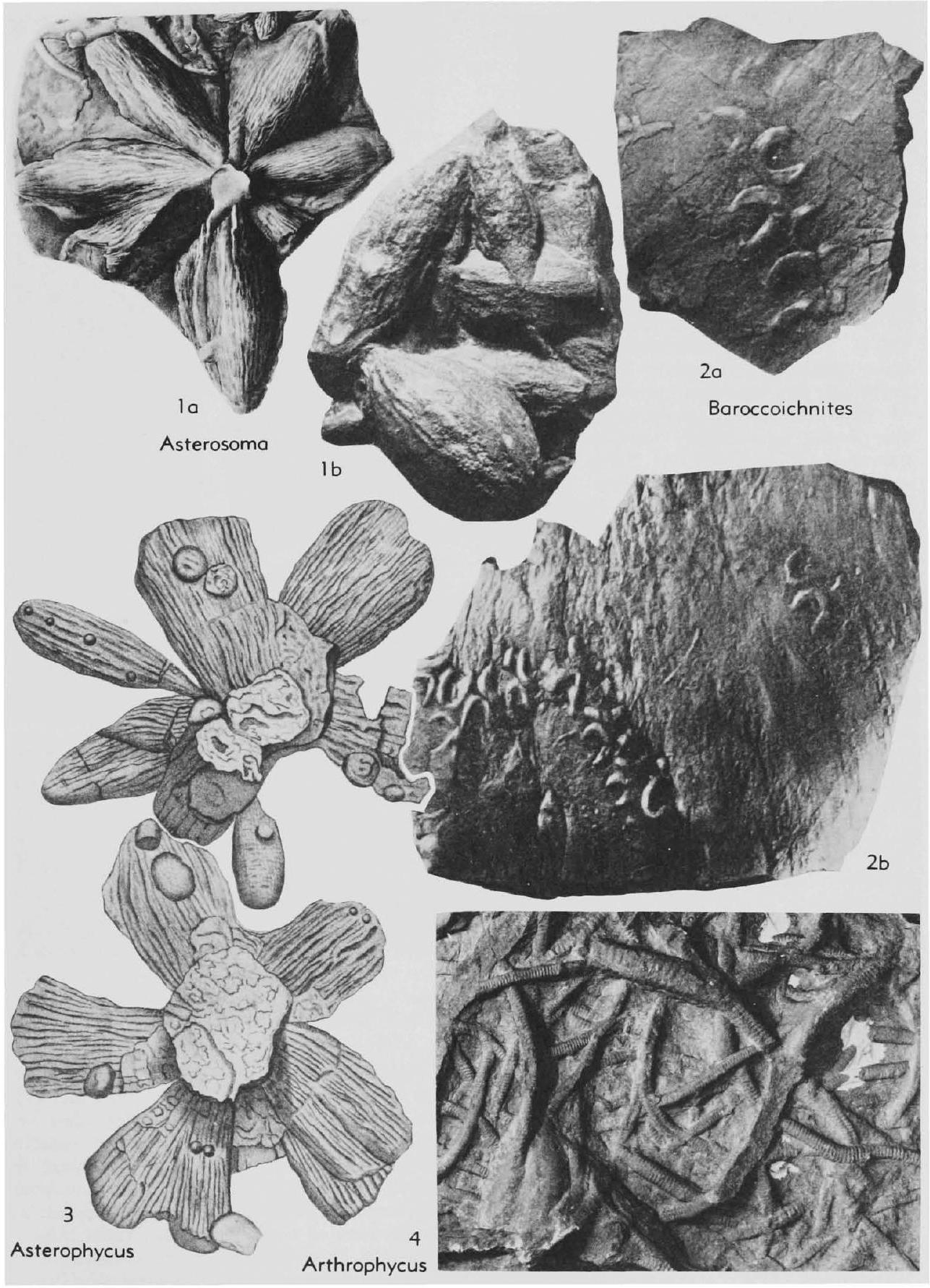 Fig. 25,1a. *A. radiciforme, U.Cret. (Turon.), Ger., X0.3 (von Otto, 1854). -- Fig. 25,1b. Asterosoma assemblage, Cruziana facies, Dev., Libya, X0.7 (Seilacher, 1969a)
Synonyms
Rosselia
Geographic Distribution
Precam., USA(Ariz.), Paleoz., Libya-Pak., ?Paleoz., Eu.(Ger.-Nor.)-USA (Okla.), ?M.Jur., G.Brit.(Eng.), ?U.Jur., Eu. (France), ?L.Cret., Eu. (Ger.), U.Cret.(Turon.), Eu.(Ger.-Czech.), ?U.Cret., USA(Kans.-Utah)
Age Range
Beginning Stage in Treatise Usage:
Precam., Paleoz.
Beginning International Stage:
Fortunian
Fraction Up In Beginning Stage:
0
Beginning Date:
538.8
Ending Stage in Treatise Usage:
U.Jur., ?L.Cret., U.Cret.(Turon.)
Ending International Stage:
Turonian
Fraction Up In Ending Stage:
100
Ending Date:
89.39
Description
Big stars diameter about 20 cm, with elevated center, about 3 to 9 rays, bulbous, tapering toward ends, longitudinally wrinkled, of different length, 2 of them mostly lying in same direction and commonly longer than other ones, rays sometimes do not radiate in all directions but form only acute-angled sector, longitudinally wrinkled. [Very probably burrows with radiating feeding trails; the Mesozoic forms suggested by ALTEVOGT (l968a) and HANTZSCHEL to have been made by decapod crustaceans.] [HANTZSCHEL agreed with GLAESSNER (1969, p. 375) that the following forms very probably have been incorrectly assigned to Asterosoma: FARROW'S (1966) stellate structures (M. Jur., Eng.); three " forms" described as Asterosoma by FREY & HOWARD (1970) from the Upper Cretaceous of USA; and a starlike trace fossil from the Lower Tertiary (Paleoc.) of England (DURKIN, 1968). Similar starlike trace fossils were described from Paleozoic rocks partly as Asterosoma (Sil., Nor., SEILACHER & MEISCHNER, 1965, p. 616; Dev., Libya, SEILACHER, 1969a, p. 122) and partly as Rosselia DAHMER, 1937 (L.Cam., Pak., SElLACHER, 1955, p. 389; L.Dev., Ger., DAHMER, 1937, p. 532); for Asterosoma? canyonensis (BASSLER) (Precam., USA) see GLAESSNER (1969, p. 375). Rosselia has been regarded by SEILACHER (l969a, p. 122) as junior synonym, but as yet, no detailed discussion has been published.]
References
Museum or Author Information
Classification
Phylum:
Trace Fossils and Problematica
Class:
Trace Fossils
Formal Genus Name and Reference:
Asterosoma von OTTO, 1854, p. 15
Type Species:
* A. radiciforme, M
Images
(Click to enlarge in a new window)
Fig. 25,1a. *A. radiciforme, U.Cret. (Turon.), Ger., X0.3 (von Otto, 1854). -- Fig. 25,1b. Asterosoma assemblage, Cruziana facies, Dev., Libya, X0.7 (Seilacher, 1969a)
Synonyms
Rosselia
Geographic Distribution
Precam., USA(Ariz.), Paleoz., Libya-Pak., ?Paleoz., Eu.(Ger.-Nor.)-USA (Okla.), ?M.Jur., G.Brit.(Eng.), ?U.Jur., Eu. (France), ?L.Cret., Eu. (Ger.), U.Cret.(Turon.), Eu.(Ger.-Czech.), ?U.Cret., USA(Kans.-Utah)
Age Range
Beginning Stage in Treatise Usage:
Precam., Paleoz.
Beginning International Stage:
Fortunian
Fraction Up In Beginning Stage:
0
Beginning Date:
538.8
Ending Stage in Treatise Usage:
U.Jur., ?L.Cret., U.Cret.(Turon.)
Ending International Stage:
Turonian
Fraction Up In Ending Stage:
100
Ending Date:
89.39
Description
Big stars diameter about 20 cm, with elevated center, about 3 to 9 rays, bulbous, tapering toward ends, longitudinally wrinkled, of different length, 2 of them mostly lying in same direction and commonly longer than other ones, rays sometimes do not radiate in all directions but form only acute-angled sector, longitudinally wrinkled. [Very probably burrows with radiating feeding trails; the Mesozoic forms suggested by ALTEVOGT (l968a) and HANTZSCHEL to have been made by decapod crustaceans.] [HANTZSCHEL agreed with GLAESSNER (1969, p. 375) that the following forms very probably have been incorrectly assigned to Asterosoma: FARROW'S (1966) stellate structures (M. Jur., Eng.); three " forms" described as Asterosoma by FREY & HOWARD (1970) from the Upper Cretaceous of USA; and a starlike trace fossil from the Lower Tertiary (Paleoc.) of England (DURKIN, 1968). Similar starlike trace fossils were described from Paleozoic rocks partly as Asterosoma (Sil., Nor., SEILACHER & MEISCHNER, 1965, p. 616; Dev., Libya, SEILACHER, 1969a, p. 122) and partly as Rosselia DAHMER, 1937 (L.Cam., Pak., SElLACHER, 1955, p. 389; L.Dev., Ger., DAHMER, 1937, p. 532); for Asterosoma? canyonensis (BASSLER) (Precam., USA) see GLAESSNER (1969, p. 375). Rosselia has been regarded by SEILACHER (l969a, p. 122) as junior synonym, but as yet, no detailed discussion has been published.]