
Welcome to the Tracefossils subsite on Invertebrate Paleontology!
Please enter a genera name to retrieve more information.
Bergaueria
Classification
Phylum:
Trace Fossils and Problematica
Class:
Trace Fossils
Formal Genus Name and Reference:
Bergaueria PRANTL, 1946, p. 50
Type Species:
*B. perata, OD
Images
(Click to enlarge in a new window)
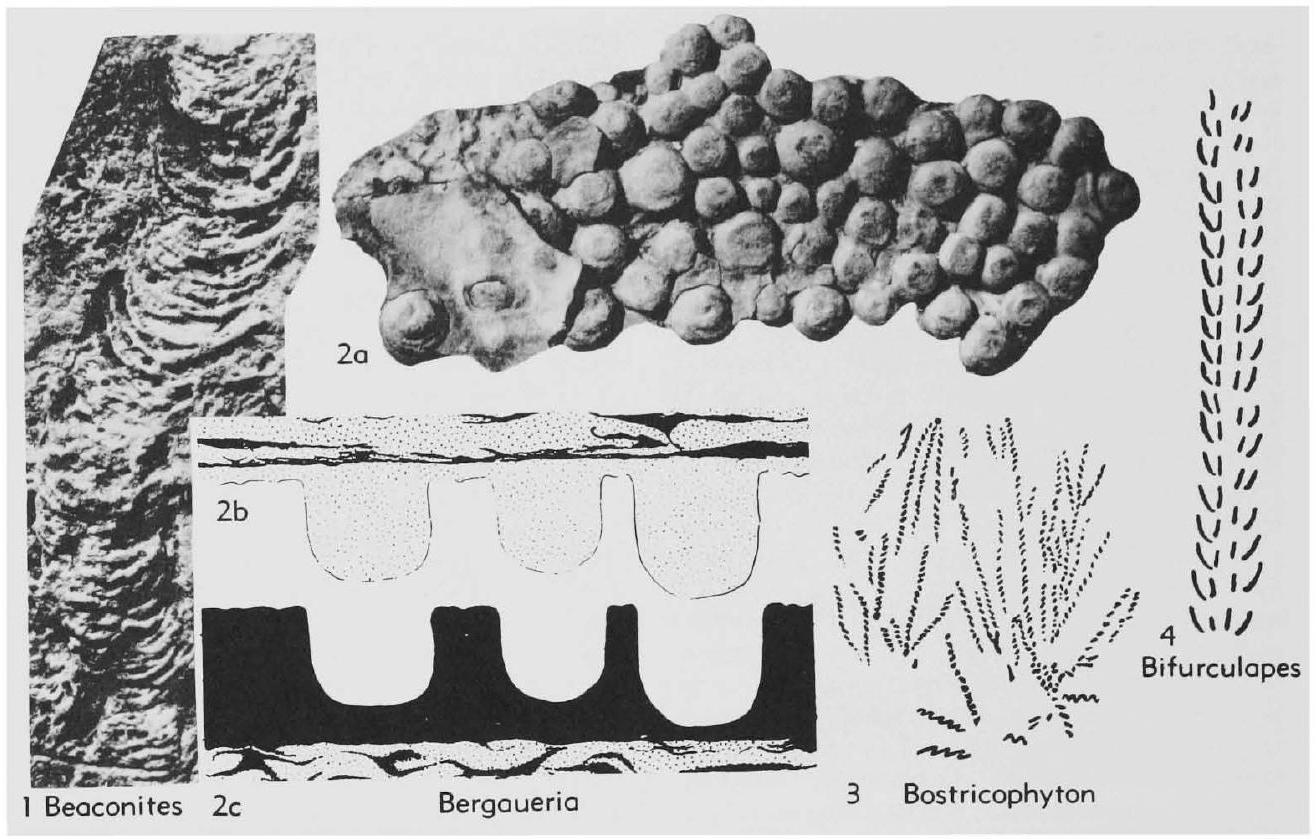 Fig. 28,2a. B. sp., ventral surface of colony, L.Cam., Can.(Moraine Lake, Banff Area, Alta.); X 0.17 (Arai & McGugan, 1968). -- Fig. 28,2b,c. *B. perata, Ord., Czech.; 2b, casts in overlying sandstone; 2c, original burrow-cavities in underlying shale, X0.3 (Prantl, 1946).
Synonyms
Palaeactis
Geographic Distribution
N.Am. (USA-Can.) -Eu.
Age Range
Beginning Stage in Treatise Usage:
Cam.
Beginning International Stage:
Fortunian
Fraction Up In Beginning Stage:
0
Beginning Date:
538.8
Ending Stage in Treatise Usage:
Ord.
Ending International Stage:
Hirnantian
Fraction Up In Ending Stage:
100
Ending Date:
443.07
Description
Cylindrical or baglike protrusions with smooth walls; length and diameter subequal (2–4 cm); lower end rounded, with shallow depression which is sometimes surrounded by 6 to 8 very short radially arranged tubercles; some specimens (L.Cam., Nev.) display biradially symmetrical impressions on ventral surface. [Probably resting burrows of suspensionfeeding coelenterate, possibly of actinian anemones (ALPERT, 1973); comparisons have been made with Edwardsia or Phyllactis conguilegia; for detailed discussion of the origin see ARAI & McGUGAN (1968, p. 206).]
References
Museum or Author Information
Classification
Phylum:
Trace Fossils and Problematica
Class:
Trace Fossils
Formal Genus Name and Reference:
Bergaueria PRANTL, 1946, p. 50
Type Species:
*B. perata, OD
Images
(Click to enlarge in a new window)
Fig. 28,2a. B. sp., ventral surface of colony, L.Cam., Can.(Moraine Lake, Banff Area, Alta.); X 0.17 (Arai & McGugan, 1968). -- Fig. 28,2b,c. *B. perata, Ord., Czech.; 2b, casts in overlying sandstone; 2c, original burrow-cavities in underlying shale, X0.3 (Prantl, 1946).
Synonyms
Palaeactis
Geographic Distribution
N.Am. (USA-Can.) -Eu.
Age Range
Beginning Stage in Treatise Usage:
Cam.
Beginning International Stage:
Fortunian
Fraction Up In Beginning Stage:
0
Beginning Date:
538.8
Ending Stage in Treatise Usage:
Ord.
Ending International Stage:
Hirnantian
Fraction Up In Ending Stage:
100
Ending Date:
443.07
Description
Cylindrical or baglike protrusions with smooth walls; length and diameter subequal (2–4 cm); lower end rounded, with shallow depression which is sometimes surrounded by 6 to 8 very short radially arranged tubercles; some specimens (L.Cam., Nev.) display biradially symmetrical impressions on ventral surface. [Probably resting burrows of suspensionfeeding coelenterate, possibly of actinian anemones (ALPERT, 1973); comparisons have been made with Edwardsia or Phyllactis conguilegia; for detailed discussion of the origin see ARAI & McGUGAN (1968, p. 206).]