
Welcome to the Tracefossils subsite on Invertebrate Paleontology!
Please enter a genera name to retrieve more information.

Chuaria
Classification
Phylum:
Trace Fossils and Problematica
Class:
Body Fossils
Formal Genus Name and Reference:
Chuaria WALCOTT, 1899, p. 234
Type Species:
*C. circularis, M
Images
(Click to enlarge in a new window)
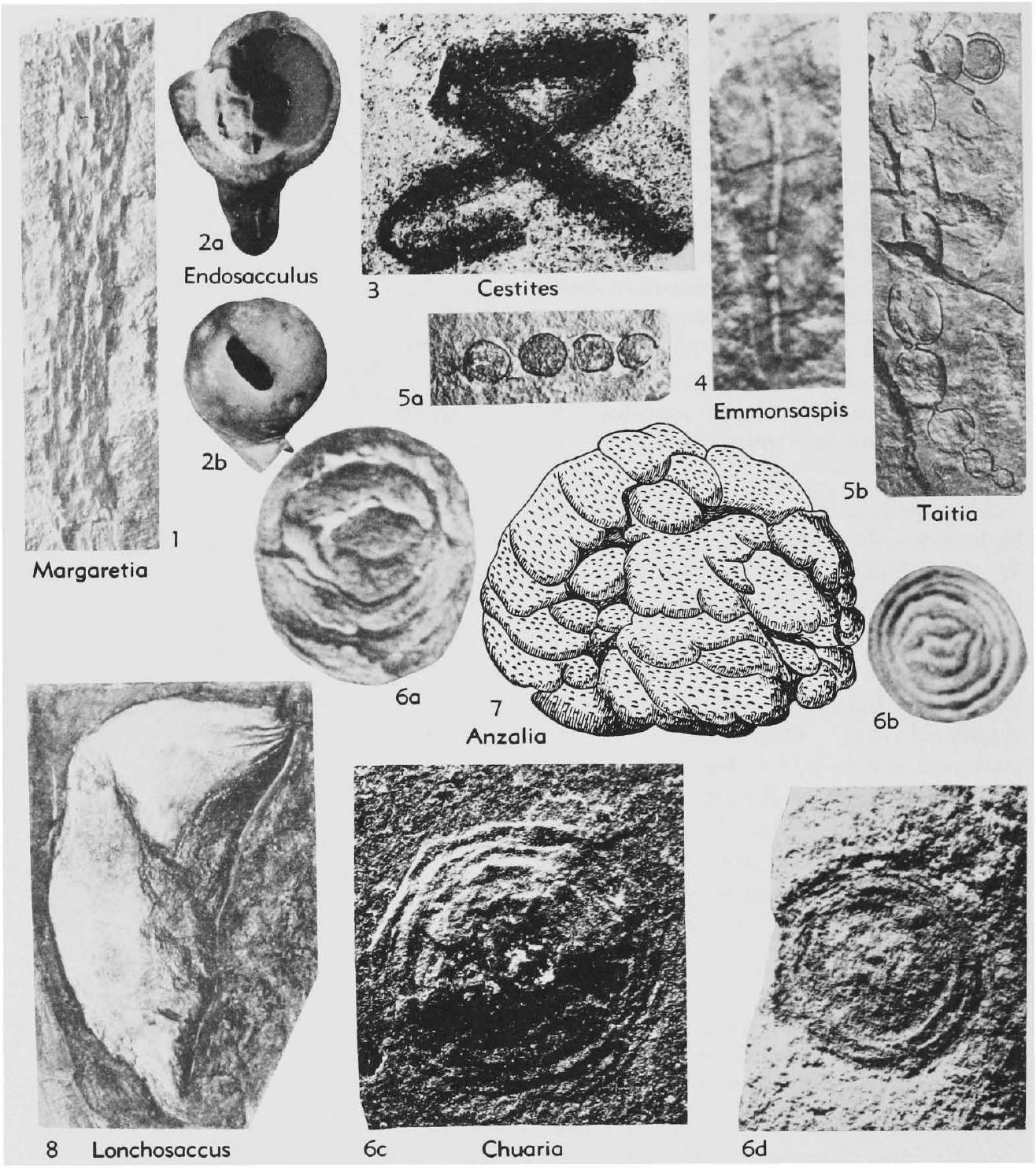 Fig. 91,6. *C. circularis, U. Precam., USA(Ariz.), X12 (Walcott, 1899); 6c, X7 (Gussow, 1973), 6d, X7 (Ford & Breed, 1973b)
Synonyms
Geographic Distribution
USA, Can., Eu. (Swed.), USSR
Age Range
Beginning Stage in Treatise Usage:
Precam.
Beginning International Stage:
Ediacaran
Fraction Up In Beginning Stage:
0
Beginning Date:
635
Ending Stage in Treatise Usage:
Precam.
Ending International Stage:
Ediacaran
Fraction Up In Ending Stage:
100
Ending Date:
538.8
Description
Disclike bodies resembling conical shells of discinoid or patelloid shape, concentrically wrinkled, dark bituminous matter covering surface. [Originally interpreted as brachiopod-like fossils (remains of a compressed conical discinoid shell); according to SCHINDEWOLF (1956) possibly small, wrinkled clay galls or concretions; CLOUD (1968) regarded the type species and Chuana wimani BROTZEN as algae; EISENACK (1966) considered C. wimani (Precam., Swed.) unrecognizable, neither gastropod nor brachiopod, nor eggs of trilobites, nor hystrichosphaerid, nor megaspore, but perhaps ?chitinous foraminifer; HOFMANN (1971, p. 24) considered the genus to be compressed globular bodies of biologic or nonbiologic origin. Gussow (1973, p. 1111) considered Chuaria to be of definite organic origin, either a large planktonic organism or a cyst or spore sac. FORD & BREED (1973a, p. 1257; 1973b, p. 547) regarded Chuaria to' be algal in origin and classified it as a sphaeromorphid acritarch.]
References
Museum or Author Information
Classification
Phylum:
Trace Fossils and Problematica
Class:
Body Fossils
Formal Genus Name and Reference:
Chuaria WALCOTT, 1899, p. 234
Type Species:
*C. circularis, M
Images
(Click to enlarge in a new window)
Fig. 91,6. *C. circularis, U. Precam., USA(Ariz.), X12 (Walcott, 1899); 6c, X7 (Gussow, 1973), 6d, X7 (Ford & Breed, 1973b)
Synonyms
Geographic Distribution
USA, Can., Eu. (Swed.), USSR
Age Range
Beginning Stage in Treatise Usage:
Precam.
Beginning International Stage:
Ediacaran
Fraction Up In Beginning Stage:
0
Beginning Date:
635
Ending Stage in Treatise Usage:
Precam.
Ending International Stage:
Ediacaran
Fraction Up In Ending Stage:
100
Ending Date:
538.8
Description
Disclike bodies resembling conical shells of discinoid or patelloid shape, concentrically wrinkled, dark bituminous matter covering surface. [Originally interpreted as brachiopod-like fossils (remains of a compressed conical discinoid shell); according to SCHINDEWOLF (1956) possibly small, wrinkled clay galls or concretions; CLOUD (1968) regarded the type species and Chuana wimani BROTZEN as algae; EISENACK (1966) considered C. wimani (Precam., Swed.) unrecognizable, neither gastropod nor brachiopod, nor eggs of trilobites, nor hystrichosphaerid, nor megaspore, but perhaps ?chitinous foraminifer; HOFMANN (1971, p. 24) considered the genus to be compressed globular bodies of biologic or nonbiologic origin. Gussow (1973, p. 1111) considered Chuaria to be of definite organic origin, either a large planktonic organism or a cyst or spore sac. FORD & BREED (1973a, p. 1257; 1973b, p. 547) regarded Chuaria to' be algal in origin and classified it as a sphaeromorphid acritarch.]