
Welcome to the Tracefossils subsite on Invertebrate Paleontology!
Please enter a genera name to retrieve more information.

Curvolithus
Classification
Phylum:
Trace Fossils and Problematica
Class:
Trace Fossils
Formal Genus Name and Reference:
Curvolithus FRITSCH, 1908, p. 13
Type Species:
* C. multiplex, SD HÄNTZSCHEL, 1962, p. W189
Images
(Click to enlarge in a new window)
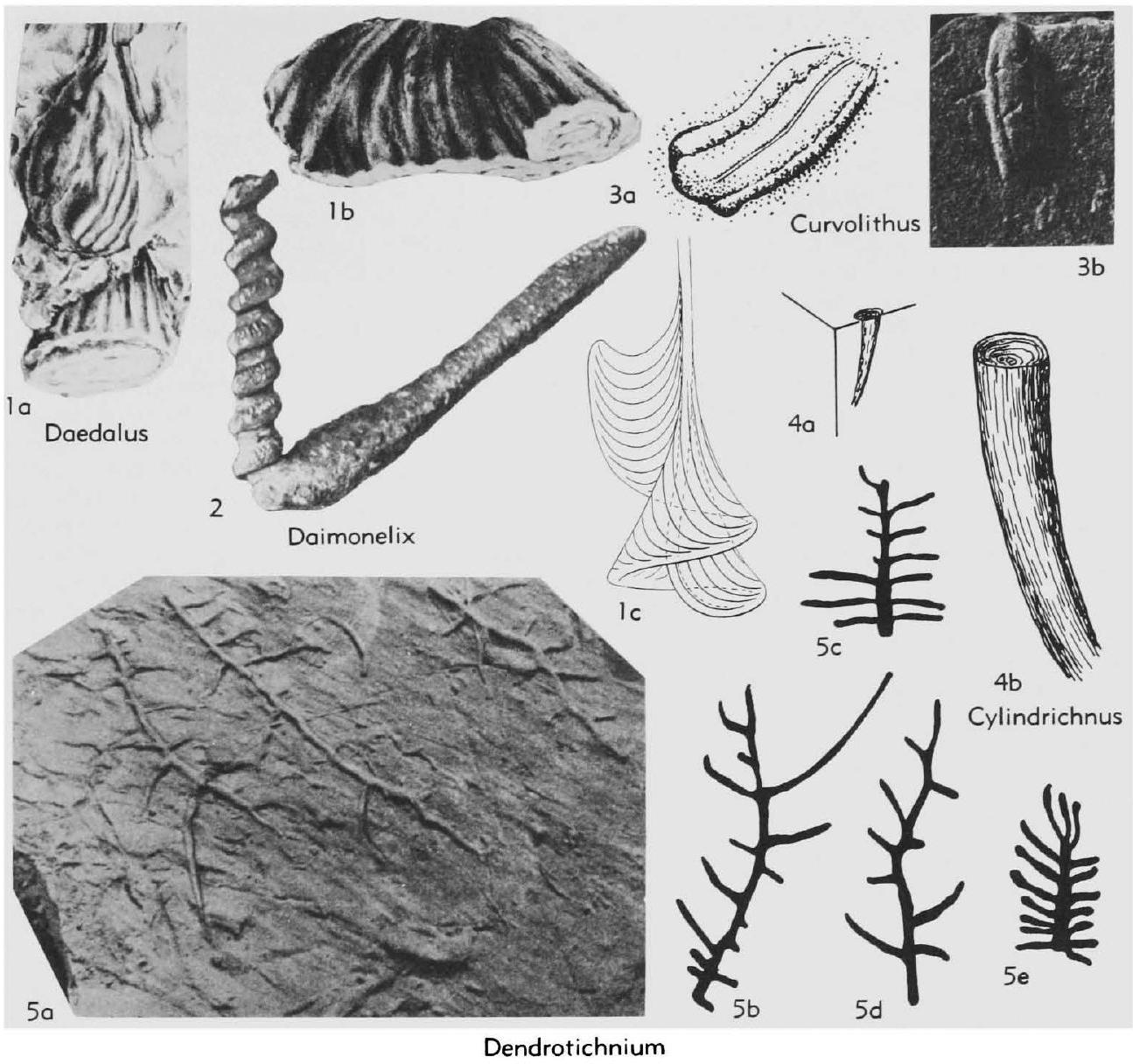 Fig. 36,3a. C. sp., M.Jur., Ger.; X0.7 (Seilacher, 1955). -- Fig. 36,3b. Curvolithus FRITSCH, Low. Lias (Hettang.), Ger. (Helmstedt); Xl.3 (Hiintzschel & Reineck, 1968)
Synonyms
Geographic Distribution
Precam., Australia; Ord., Eu.(Czech.); Sil., USA (Ga.); Penn., USA (Okla.) ; L.fur.-M.fur., Eu.(Ger.)-Greenl.; Cret., Eu.(Ger.); Tert.(? Mio.} , Borneo (But see Comment in the Description)
Age Range
Beginning Stage in Treatise Usage:
Precam., Ord., Sil. (But see comments)
Beginning International Stage:
Rhuddanian
Fraction Up In Beginning Stage:
0
Beginning Date:
443.07
Ending Stage in Treatise Usage:
Cret., ?Tert.(Mio.) (But see comments)
Ending International Stage:
Maastrichtian
Fraction Up In Ending Stage:
100
Ending Date:
66.04
Description
Ribbonlike trails, more or less straight, flat, consisting of 3 parts: broad, usually smooth central stripe (about 0.5 to 2 cm wide) and very narrow lateral ridges (1 to 2 mm wide) [Endichnial crawling trails, also cutting bedding planes and passing over and under each other, probably produced by burrowing gastropods.] [Two varied types of the genus described by HEINBERG (1970, p. 23); perhaps the grooved pipes described by KEI] (1965, p. 226) (Mio., Borneo) should also be placed in Curvolithus as proposed by CHAMBERLAIN (1971a, p. 224). Identity of the Ordovician specimens with the Jurassic ones is not yet proved; C. gregarius FRITSCH, 1908, p. 13, differs distinctly from the type species.]
References
Museum or Author Information
Classification
Phylum:
Trace Fossils and Problematica
Class:
Trace Fossils
Formal Genus Name and Reference:
Curvolithus FRITSCH, 1908, p. 13
Type Species:
* C. multiplex, SD HÄNTZSCHEL, 1962, p. W189
Images
(Click to enlarge in a new window)
Fig. 36,3a. C. sp., M.Jur., Ger.; X0.7 (Seilacher, 1955). -- Fig. 36,3b. Curvolithus FRITSCH, Low. Lias (Hettang.), Ger. (Helmstedt); Xl.3 (Hiintzschel & Reineck, 1968)
Synonyms
Geographic Distribution
Precam., Australia; Ord., Eu.(Czech.); Sil., USA (Ga.); Penn., USA (Okla.) ; L.fur.-M.fur., Eu.(Ger.)-Greenl.; Cret., Eu.(Ger.); Tert.(? Mio.} , Borneo (But see Comment in the Description)
Age Range
Beginning Stage in Treatise Usage:
Precam., Ord., Sil. (But see comments)
Beginning International Stage:
Rhuddanian
Fraction Up In Beginning Stage:
0
Beginning Date:
443.07
Ending Stage in Treatise Usage:
Cret., ?Tert.(Mio.) (But see comments)
Ending International Stage:
Maastrichtian
Fraction Up In Ending Stage:
100
Ending Date:
66.04
Description
Ribbonlike trails, more or less straight, flat, consisting of 3 parts: broad, usually smooth central stripe (about 0.5 to 2 cm wide) and very narrow lateral ridges (1 to 2 mm wide) [Endichnial crawling trails, also cutting bedding planes and passing over and under each other, probably produced by burrowing gastropods.] [Two varied types of the genus described by HEINBERG (1970, p. 23); perhaps the grooved pipes described by KEI] (1965, p. 226) (Mio., Borneo) should also be placed in Curvolithus as proposed by CHAMBERLAIN (1971a, p. 224). Identity of the Ordovician specimens with the Jurassic ones is not yet proved; C. gregarius FRITSCH, 1908, p. 13, differs distinctly from the type species.]