
Welcome to the Tracefossils subsite on Invertebrate Paleontology!
Please enter a genera name to retrieve more information.
Diplichnites
Classification
Phylum:
Trace Fossils and Problematica
Class:
Trace Fossils
Formal Genus Name and Reference:
Diplichnites DAWSON, 1873, p. 19
Type Species:
*D. aenigma, M
Images
(Click to enlarge in a new window)
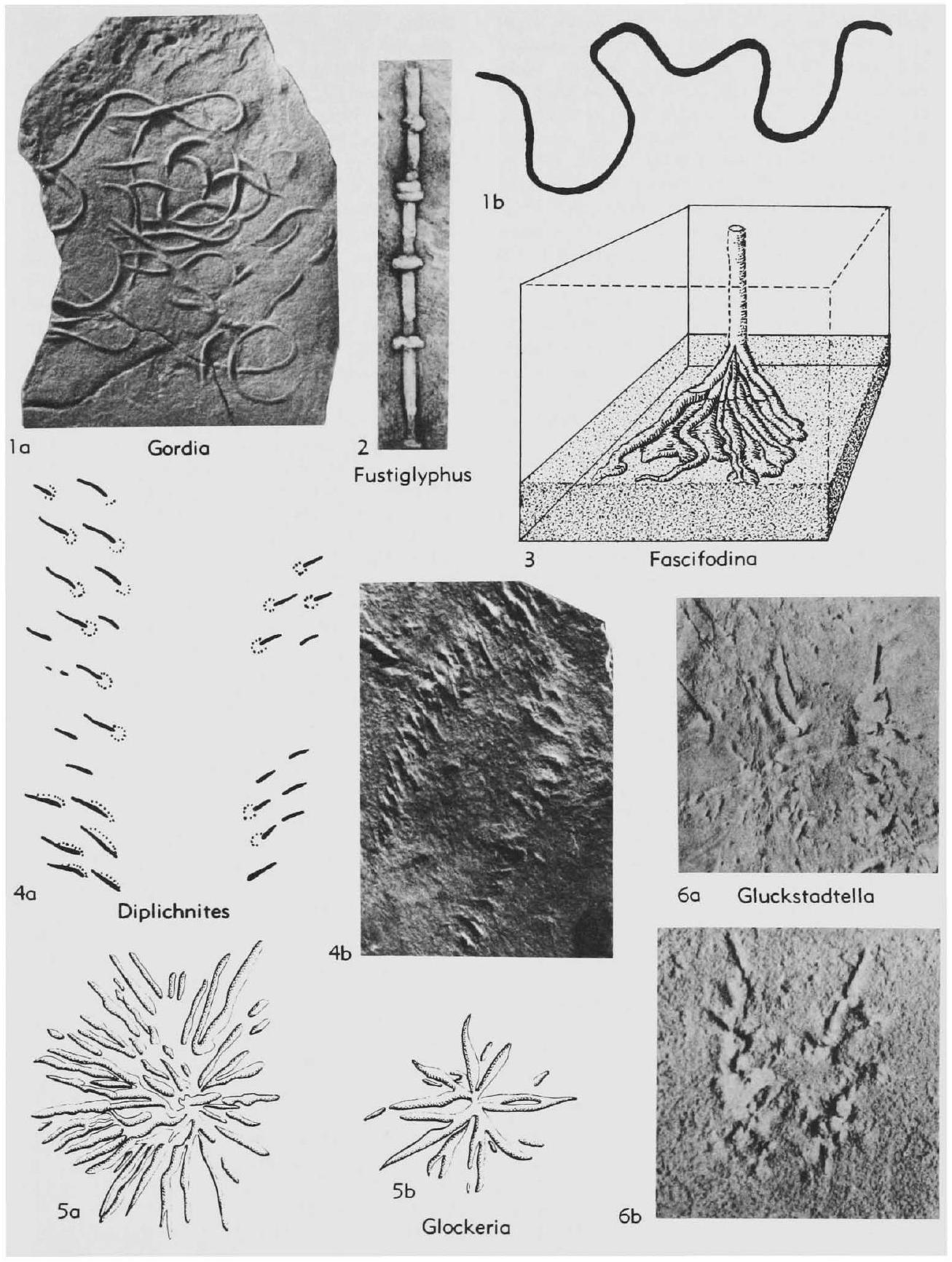
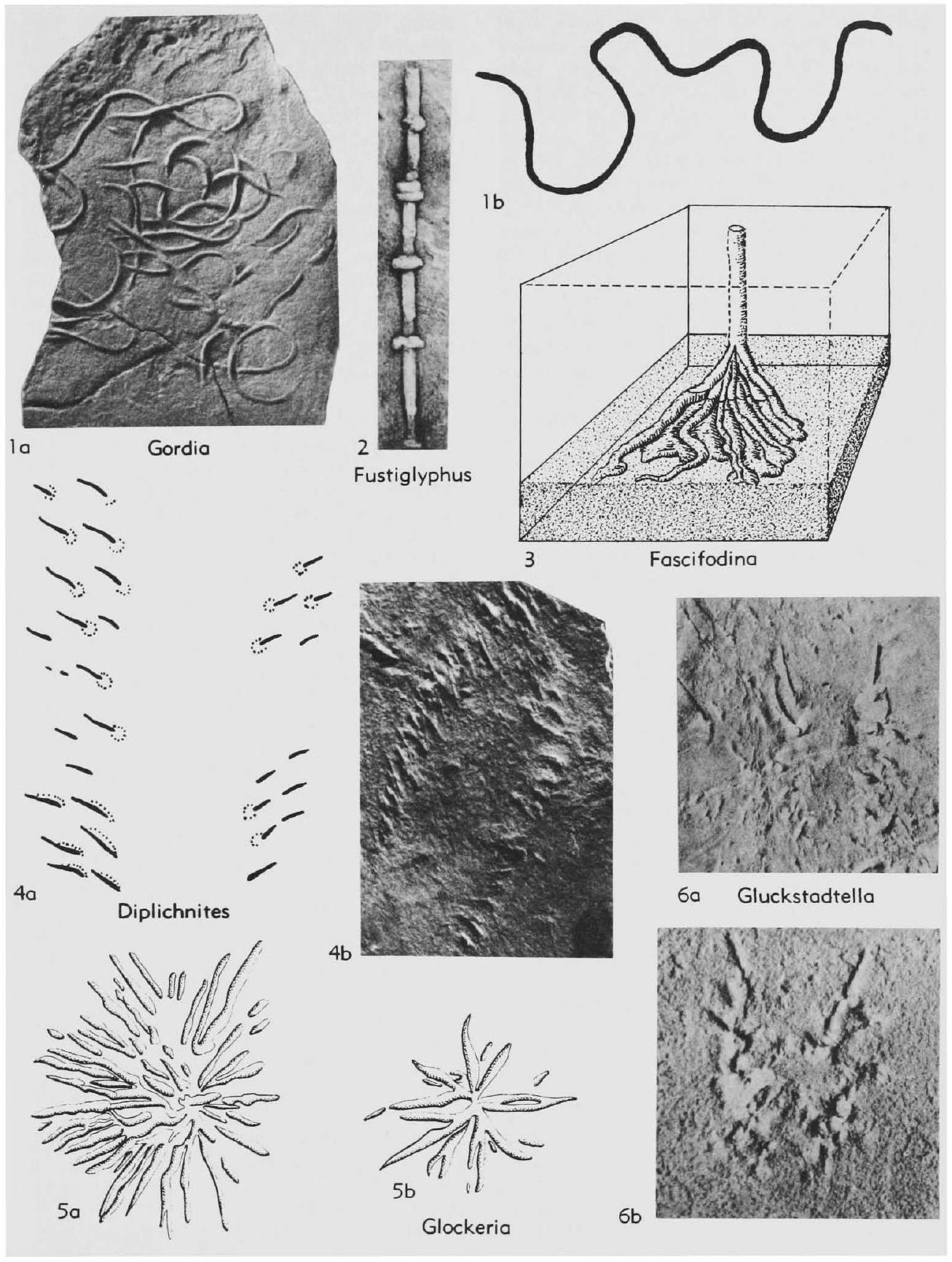 Fig. 39,4a. D. sp., L.Cam., Asia(Pak.), schem., X1.3 (Seilacher, 1955). -- Fig. 39,4b. Diplichnites, U.Cam., N.Wales, X? (from Crimes, T.P., 1970, p. 120, in Trace Fossils edited by T.P. Crimes & J.C. Harper, Geol. Jour. Spec. Issue 3, Seel House Press, Liverpool)
Synonyms
Acripes
Geographic Distribution
L.Cam., Can., Cam., Eu.(Eng.-Swed.-Pol.)-USSR(Sib.)-Greenl.-Asia(Pak.)-Australia, ?Cam., Eu.(Nor.), Ord., Eng., ?Ord., Asia (Jordan), ?Dev.-Carb., N.Am.(Can.), L.Perm. (Dwyka Gr.), S.Afr.
Age Range
Beginning Stage in Treatise Usage:
L.Cam.
Beginning International Stage:
Fortunian
Fraction Up In Beginning Stage:
0
Beginning Date:
538.8
Ending Stage in Treatise Usage:
Carb., L.Perm.
Ending International Stage:
Gzhelian
Fraction Up In Ending Stage:
100
Ending Date:
298.89
Description
Morphologically simple track, width about 1 to 2 cm, consisting of 2 parallel series of fine ridges (1.5 mm long), individual ridges elongate obliquely to track axis, sometimes apparently occurring in pairs (illustrating two-clawed limbs of animal producing track), anterior ridge then more prominent. [Originally interpreted by DAWSON as traces of large worms or crustaceans or imprints of spines of fish; now considered locomotion tracks of trilobites, walking or striding in straightfoIward movement across the surface of the sediment; CRIMES (1970b, p. 57) observed transitional forms between Diplichnites and Cruziana; OSGOOD (1970, p. 352) is skeptical about the trilobite origin and the marine environment of DAWSON'S type specimens of ichnogenus; a comparable track from the Devonian of Antarctica is Beaconic!wus gouldi GEVERS, 1971 (see GEVERS et al., 1971, p. 86, 93).]
References
Museum or Author Information
Classification
Phylum:
Trace Fossils and Problematica
Class:
Trace Fossils
Formal Genus Name and Reference:
Diplichnites DAWSON, 1873, p. 19
Type Species:
*D. aenigma, M
Images
(Click to enlarge in a new window)
Fig. 39,4a. D. sp., L.Cam., Asia(Pak.), schem., X1.3 (Seilacher, 1955). -- Fig. 39,4b. Diplichnites, U.Cam., N.Wales, X? (from Crimes, T.P., 1970, p. 120, in Trace Fossils edited by T.P. Crimes & J.C. Harper, Geol. Jour. Spec. Issue 3, Seel House Press, Liverpool)
Synonyms
Acripes
Geographic Distribution
L.Cam., Can., Cam., Eu.(Eng.-Swed.-Pol.)-USSR(Sib.)-Greenl.-Asia(Pak.)-Australia, ?Cam., Eu.(Nor.), Ord., Eng., ?Ord., Asia (Jordan), ?Dev.-Carb., N.Am.(Can.), L.Perm. (Dwyka Gr.), S.Afr.
Age Range
Beginning Stage in Treatise Usage:
L.Cam.
Beginning International Stage:
Fortunian
Fraction Up In Beginning Stage:
0
Beginning Date:
538.8
Ending Stage in Treatise Usage:
Carb., L.Perm.
Ending International Stage:
Gzhelian
Fraction Up In Ending Stage:
100
Ending Date:
298.89
Description
Morphologically simple track, width about 1 to 2 cm, consisting of 2 parallel series of fine ridges (1.5 mm long), individual ridges elongate obliquely to track axis, sometimes apparently occurring in pairs (illustrating two-clawed limbs of animal producing track), anterior ridge then more prominent. [Originally interpreted by DAWSON as traces of large worms or crustaceans or imprints of spines of fish; now considered locomotion tracks of trilobites, walking or striding in straightfoIward movement across the surface of the sediment; CRIMES (1970b, p. 57) observed transitional forms between Diplichnites and Cruziana; OSGOOD (1970, p. 352) is skeptical about the trilobite origin and the marine environment of DAWSON'S type specimens of ichnogenus; a comparable track from the Devonian of Antarctica is Beaconic!wus gouldi GEVERS, 1971 (see GEVERS et al., 1971, p. 86, 93).]