
Welcome to the Tracefossils subsite on Invertebrate Paleontology!
Please enter a genera name to retrieve more information.
Lockeia
Classification
Phylum:
Trace Fossils and Problematica
Class:
Trace Fossils
Formal Genus Name and Reference:
Lockeia U. P. JAMES, 1879, p. 17
Type Species:
L. siliquaria
Images
(Click to enlarge in a new window)
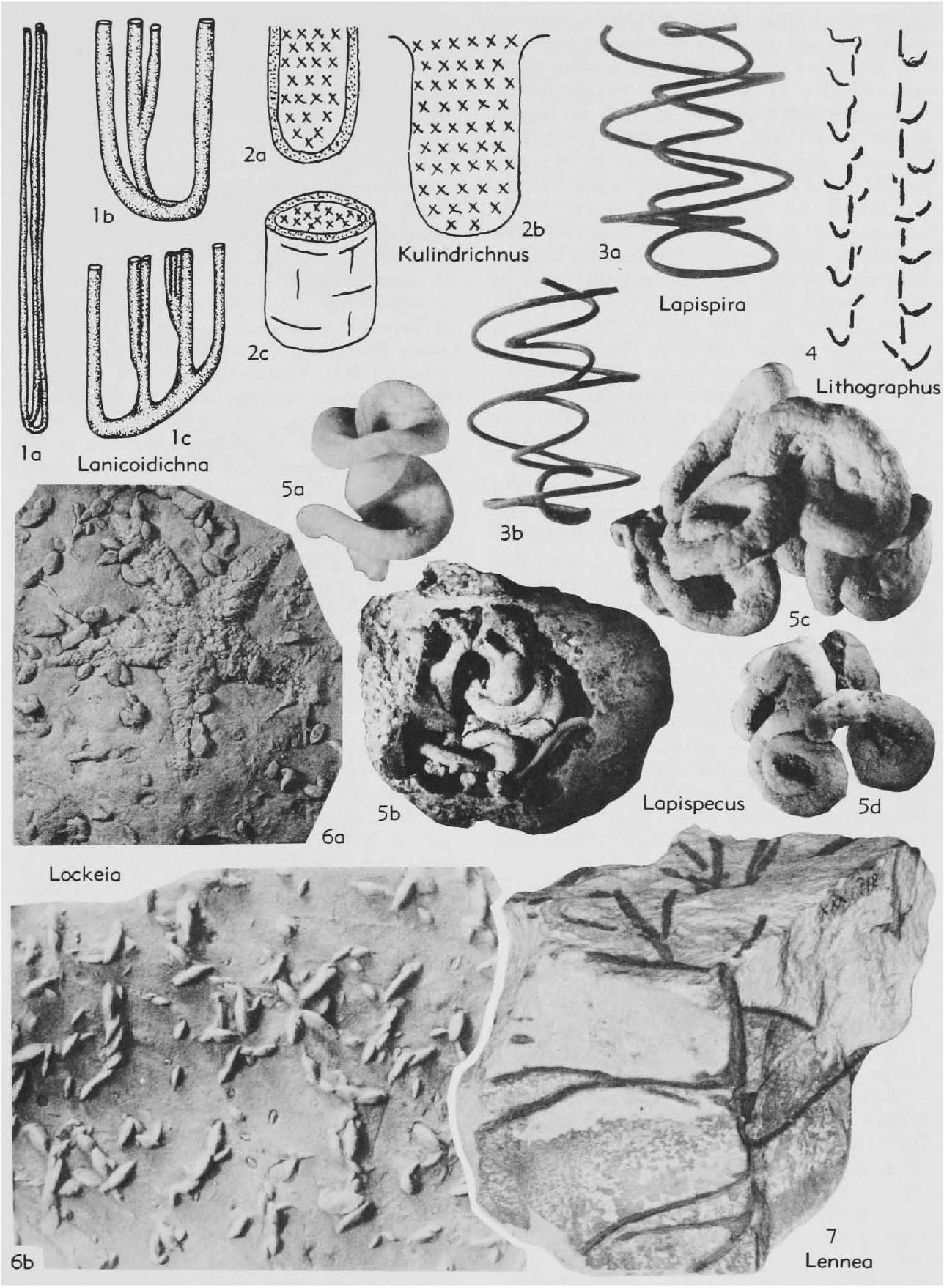 Fig. 48,6a. L. amygdaloides, M.Jur.(Dogger 13, Donzdorfer Ss.), Ger.; (shown wilh Asteriacites quinque/olius (QUENSTEDT) , X0.5 (Seilacher, 1953b). -- Fig. 48,6b. *L. siliqual'ia, Ord. (up. Trenlon. or low. Cincinnat.), Ludlow, Ky.; X0.7 (Osgood, 1970)
Synonyms
Pelecypodichnus
Geographic Distribution
Ord., Eu. (Nor.-France)-USA (Ohio-Ky.)-Can., ?Ord., S.Am.(Arg.); Penn., USA (Kans.-Okla.) ; Trias., Eu.(Ger.-Swed.-Italy) -E.Green!.; fur., Eu. (Eng.-France-Ger.-Swed.); Cret., USA (Utah) ; Tert., Eu.(Switz.)-Iraq
Age Range
Beginning Stage in Treatise Usage:
Ord., Trias.
Beginning International Stage:
Tremadocian
Fraction Up In Beginning Stage:
0
Beginning Date:
486.85
Ending Stage in Treatise Usage:
Cret., Tert.
Ending International Stage:
Gelasian
Fraction Up In Ending Stage:
100
Ending Date:
1.81
Description
Small almond-shaped oblong bodies preserved in convex hyporelief; tapering to sharp and obtuse points at both ends; surface commonly smooth; mostly symmetrical; length varying from 2 to 12 mm. [Originally interpreted as algae; later regarded by J.F. JAMES (1885) as "ovarian capsules" of graptolites; now considered resting trails of small burrowing pelecypods, perhaps semi-sessile forms; for discussion on mode of formation and synonymy with "DaU/sonia" NICHOLSON, 1873 (preoccupied by HARTT, in DAWSON, 1868), see OSGOOD, 1970, p. 208-212.] [Regrettably, the most appropriate name Pelecypodiclmus must be replaced by a very rarely used one published in an obscure journal!]
References
Museum or Author Information
Classification
Phylum:
Trace Fossils and Problematica
Class:
Trace Fossils
Formal Genus Name and Reference:
Lockeia U. P. JAMES, 1879, p. 17
Type Species:
L. siliquaria
Images
(Click to enlarge in a new window)
Fig. 48,6a. L. amygdaloides, M.Jur.(Dogger 13, Donzdorfer Ss.), Ger.; (shown wilh Asteriacites quinque/olius (QUENSTEDT) , X0.5 (Seilacher, 1953b). -- Fig. 48,6b. *L. siliqual'ia, Ord. (up. Trenlon. or low. Cincinnat.), Ludlow, Ky.; X0.7 (Osgood, 1970)
Synonyms
Pelecypodichnus
Geographic Distribution
Ord., Eu. (Nor.-France)-USA (Ohio-Ky.)-Can., ?Ord., S.Am.(Arg.); Penn., USA (Kans.-Okla.) ; Trias., Eu.(Ger.-Swed.-Italy) -E.Green!.; fur., Eu. (Eng.-France-Ger.-Swed.); Cret., USA (Utah) ; Tert., Eu.(Switz.)-Iraq
Age Range
Beginning Stage in Treatise Usage:
Ord., Trias.
Beginning International Stage:
Tremadocian
Fraction Up In Beginning Stage:
0
Beginning Date:
486.85
Ending Stage in Treatise Usage:
Cret., Tert.
Ending International Stage:
Gelasian
Fraction Up In Ending Stage:
100
Ending Date:
1.81
Description
Small almond-shaped oblong bodies preserved in convex hyporelief; tapering to sharp and obtuse points at both ends; surface commonly smooth; mostly symmetrical; length varying from 2 to 12 mm. [Originally interpreted as algae; later regarded by J.F. JAMES (1885) as "ovarian capsules" of graptolites; now considered resting trails of small burrowing pelecypods, perhaps semi-sessile forms; for discussion on mode of formation and synonymy with "DaU/sonia" NICHOLSON, 1873 (preoccupied by HARTT, in DAWSON, 1868), see OSGOOD, 1970, p. 208-212.] [Regrettably, the most appropriate name Pelecypodiclmus must be replaced by a very rarely used one published in an obscure journal!]