
Welcome to the Tracefossils subsite on Invertebrate Paleontology!
Please enter a genera name to retrieve more information.
Newlandia
Classification
Phylum:
Trace Fossils and Problematica
Class:
Pseudo-fossils
Formal Genus Name and Reference:
Newlandia WALCOTT, 1914, p. 104
Type Species:
*N. frondosa, OD
Images
(Click to enlarge in a new window)
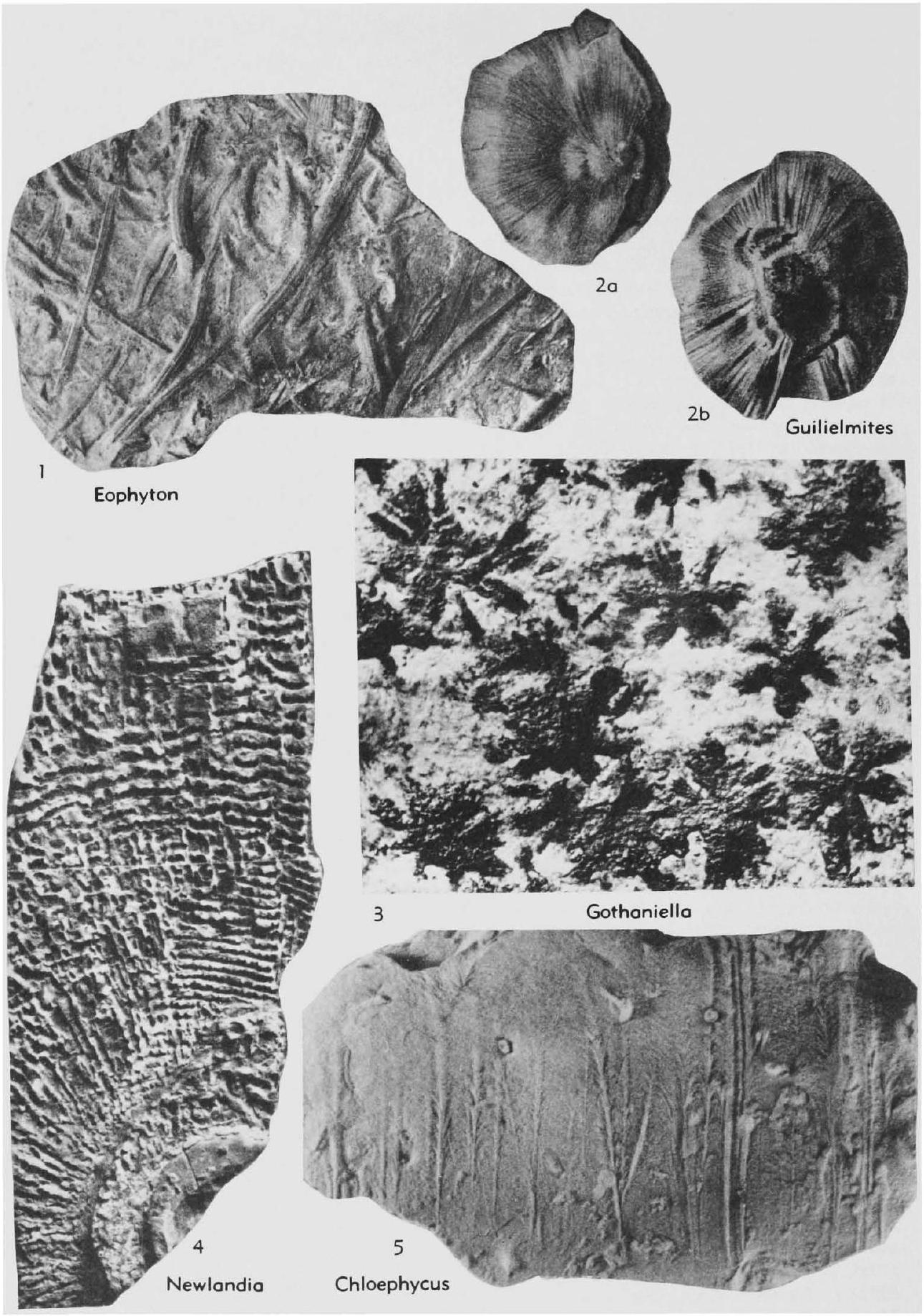 Fig. 103,4. *N. frondosa, Precam. (Belt Ser., Newland Ls.), USA (Mont.); upper surface, large frond, X0.5 (Walcott, 1914)
Synonyms
Geographic Distribution
Precam., USA(Mont.)-W.Australia; Perm., G.Brit. (Eng.); Trias., Eu.(Spain)
Age Range
Beginning Stage in Treatise Usage:
Precam., Perm.
Beginning International Stage:
Fraction Up In Beginning Stage:
Beginning Date:
Ending Stage in Treatise Usage:
Trias.
Ending International Stage:
Fraction Up In Ending Stage:
Ending Date:
Description
Irregular hemispherical or bowl-shaped bodies; diameter up to 80 cm, consisting of concentric, subparallel, subequidistant layers; similar to Collenia or Cryptozoon. [Interpreted as algae by WALCOTT (1914), FENTON & FENTON (1936), and EDGELL (1964); according to PIA (1936) (describing and discussing similar Triassic specimens from Spain called " Newlandien" ), inorganic in origin (rhythmical precipitates); other similar forms found by HOLTEDAHL (1921) in Permian of England and explained as inorganic structures; regarded by SCHINDEWOLF (1956) and GLAESSNER (1962, p. 471) as formed by diagenetic processes.]
References
Museum or Author Information
Classification
Phylum:
Trace Fossils and Problematica
Class:
Pseudo-fossils
Formal Genus Name and Reference:
Newlandia WALCOTT, 1914, p. 104
Type Species:
*N. frondosa, OD
Images
(Click to enlarge in a new window)
Fig. 103,4. *N. frondosa, Precam. (Belt Ser., Newland Ls.), USA (Mont.); upper surface, large frond, X0.5 (Walcott, 1914)
Synonyms
Geographic Distribution
Precam., USA(Mont.)-W.Australia; Perm., G.Brit. (Eng.); Trias., Eu.(Spain)
Age Range
Beginning Stage in Treatise Usage:
Precam., Perm.
Beginning International Stage:
Fraction Up In Beginning Stage:
Beginning Date:
Ending Stage in Treatise Usage:
Trias.
Ending International Stage:
Fraction Up In Ending Stage:
Ending Date:
Description
Irregular hemispherical or bowl-shaped bodies; diameter up to 80 cm, consisting of concentric, subparallel, subequidistant layers; similar to Collenia or Cryptozoon. [Interpreted as algae by WALCOTT (1914), FENTON & FENTON (1936), and EDGELL (1964); according to PIA (1936) (describing and discussing similar Triassic specimens from Spain called " Newlandien" ), inorganic in origin (rhythmical precipitates); other similar forms found by HOLTEDAHL (1921) in Permian of England and explained as inorganic structures; regarded by SCHINDEWOLF (1956) and GLAESSNER (1962, p. 471) as formed by diagenetic processes.]