
Welcome to the Tracefossils subsite on Invertebrate Paleontology!
Please enter a genera name to retrieve more information.
Ophiomorpha
Classification
Phylum:
Trace Fossils and Problematica
Class:
Trace Fossils
Formal Genus Name and Reference:
Ophiomorpha LUNDGREN, 1891, p. 114 [non SZEPLIGET, 1905]
Type Species:
*O. nodosa, M
Images
(Click to enlarge in a new window)
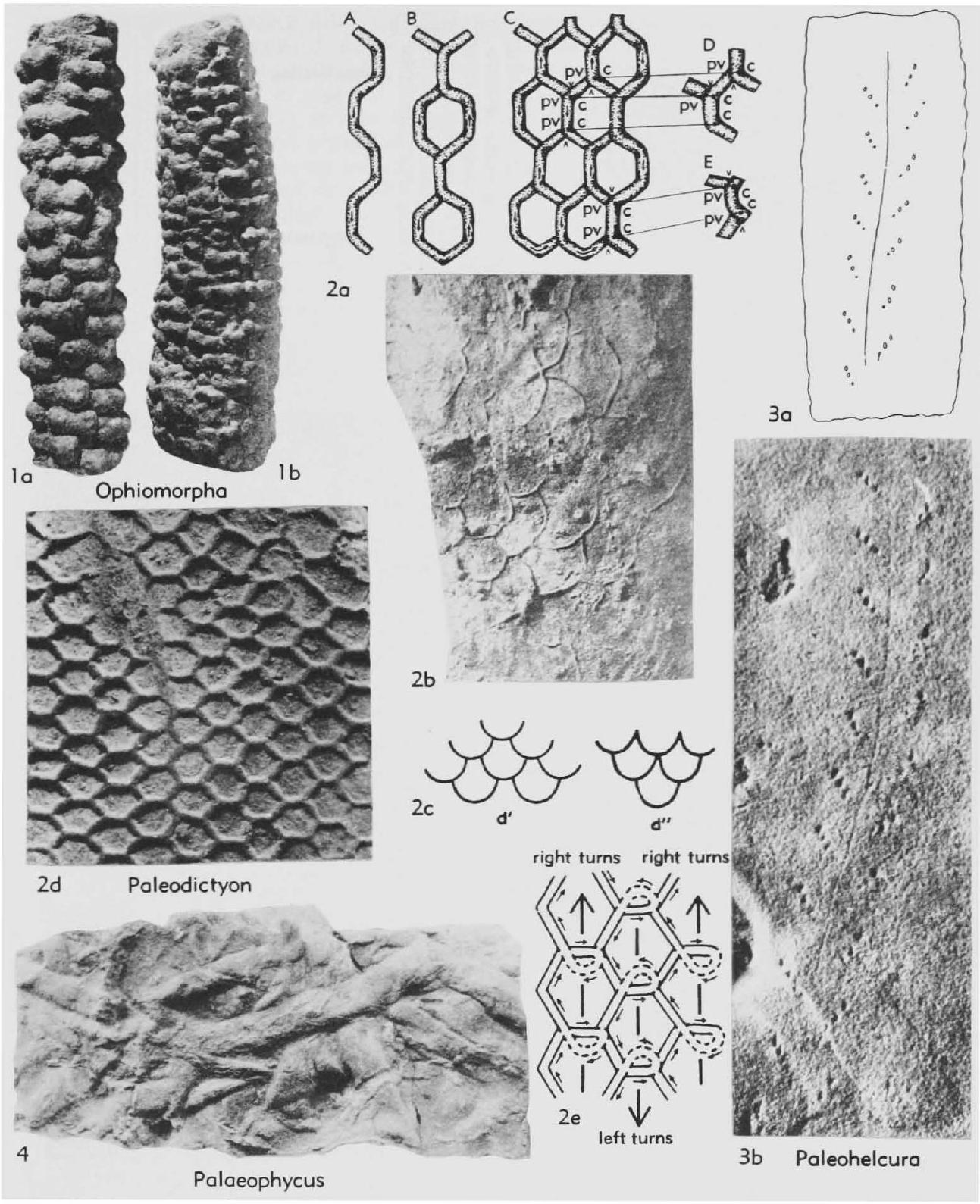
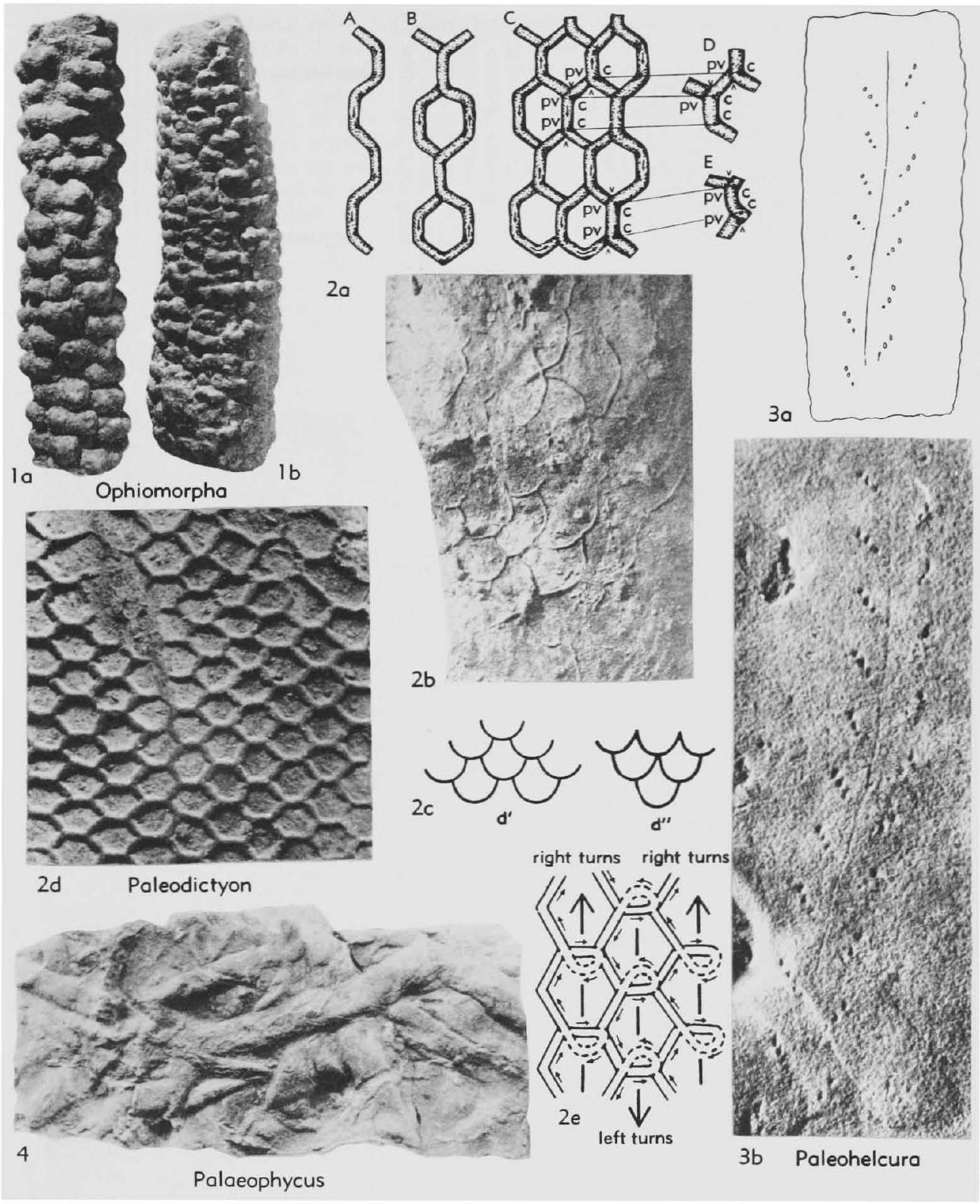 Fig. 54,1a. O. major (Lesouereux), U.Cret., USA(N. Dak.), ×0.5 (Häntzschel, 1952). -- Fig. 54,1b. *O. nodosa, ?U.Cret. or L.Tert., S.Swed. (Scania), X0.4 (Häntzschel, 1952)
Synonyms
Ophiomorpha, Cylindrites, Spongites, Halymenites, Phymatoderma, ?Broeckia
Geographic Distribution
L.Jur., Green!.; M.Jur.-Pleist., cosmop
Age Range
Beginning Stage in Treatise Usage:
L.Jur.
Beginning International Stage:
Hettangian
Fraction Up In Beginning Stage:
0
Beginning Date:
201.36
Ending Stage in Treatise Usage:
Pleist.
Ending International Stage:
Pleistocene Upper
Fraction Up In Ending Stage:
100
Ending Date:
0.01
Description
Three-dimensional burrow systems, vertical and horizontal; cylindrical tunnels (diam., 0.5-3 cm.) dichotomously branching, generally at acute angles, with local swellings close to or at points of branching; tunnels internally smooth, but outer surface of burrow lining characteristically mammillate due to presence of discoidal or ovoid pellets; which are several mm., rarely more, in diameter, tunnels may also be only partly lined by small pellets, longitudinal ridges occur on outer surface of some burrow fillings. Occasionally penetrating sediment for more than 1 m. in depth. [Doubtless to be ascribed to burrowing decapod crustaceans, particularly callianassids as proven by Ophiomorpha-like structures produced by Recent callianassids in modern sediments (WEIMER & HOYT, 1964); found associated in same rocks with Callianassa claws (Cret., Delaware) (PICKETT, et al., 1971); swellings of the tunnels are " turn-arounds" of the animals; pellets cemented by the producer and put into the sides of the burrow; reticulate ridges on some burrows are scratches made by the inhabitant of the burrow, probably during initial burrowing; passing of warty exterior into smooth burrows observed (KENNEDY & SELLWOOD, 1970, p. 108). O. borneensis KElT, 1965, has been observed rarely to exhibit vertical, spiral burrows while in close association with horizontal ones, similar forms occur in sandy Tertiary sediments of West Germany (KILPPER, 1962, p. 57); Ophiomorpha occasionally seen to pass into Thalassinoides (AGER & WALLACE, 1970, p. 8) and rarely into wall-like structures similar to Teichnichnus (HESTER & PRYOR, 1972); cylindrical burrows with smooth walls (V.Cret., Saltholm Ls., Denm.) sometimes named Ophiomorpha in museum collections; generally regarded as indicator of marine environment, especially littoral, sublittoral, or upper neritic; for discussion of interpretation of occurrences in apparently brackish or freshwater environments see KENNEDY & MACDOUGALL (1969, p. 467); for a list of the very extensive literature on this trace fossil see KENNEDY & SELLWOOD (1970, p. 101) and MULLER (196ge, 1970b»)
References
Museum or Author Information
Classification
Phylum:
Trace Fossils and Problematica
Class:
Trace Fossils
Formal Genus Name and Reference:
Ophiomorpha LUNDGREN, 1891, p. 114 [non SZEPLIGET, 1905]
Type Species:
*O. nodosa, M
Images
(Click to enlarge in a new window)
Fig. 54,1a. O. major (Lesouereux), U.Cret., USA(N. Dak.), ×0.5 (Häntzschel, 1952). -- Fig. 54,1b. *O. nodosa, ?U.Cret. or L.Tert., S.Swed. (Scania), X0.4 (Häntzschel, 1952)
Synonyms
Ophiomorpha, Cylindrites, Spongites, Halymenites, Phymatoderma, ?Broeckia
Geographic Distribution
L.Jur., Green!.; M.Jur.-Pleist., cosmop
Age Range
Beginning Stage in Treatise Usage:
L.Jur.
Beginning International Stage:
Hettangian
Fraction Up In Beginning Stage:
0
Beginning Date:
201.36
Ending Stage in Treatise Usage:
Pleist.
Ending International Stage:
Pleistocene Upper
Fraction Up In Ending Stage:
100
Ending Date:
0.01
Description
Three-dimensional burrow systems, vertical and horizontal; cylindrical tunnels (diam., 0.5-3 cm.) dichotomously branching, generally at acute angles, with local swellings close to or at points of branching; tunnels internally smooth, but outer surface of burrow lining characteristically mammillate due to presence of discoidal or ovoid pellets; which are several mm., rarely more, in diameter, tunnels may also be only partly lined by small pellets, longitudinal ridges occur on outer surface of some burrow fillings. Occasionally penetrating sediment for more than 1 m. in depth. [Doubtless to be ascribed to burrowing decapod crustaceans, particularly callianassids as proven by Ophiomorpha-like structures produced by Recent callianassids in modern sediments (WEIMER & HOYT, 1964); found associated in same rocks with Callianassa claws (Cret., Delaware) (PICKETT, et al., 1971); swellings of the tunnels are " turn-arounds" of the animals; pellets cemented by the producer and put into the sides of the burrow; reticulate ridges on some burrows are scratches made by the inhabitant of the burrow, probably during initial burrowing; passing of warty exterior into smooth burrows observed (KENNEDY & SELLWOOD, 1970, p. 108). O. borneensis KElT, 1965, has been observed rarely to exhibit vertical, spiral burrows while in close association with horizontal ones, similar forms occur in sandy Tertiary sediments of West Germany (KILPPER, 1962, p. 57); Ophiomorpha occasionally seen to pass into Thalassinoides (AGER & WALLACE, 1970, p. 8) and rarely into wall-like structures similar to Teichnichnus (HESTER & PRYOR, 1972); cylindrical burrows with smooth walls (V.Cret., Saltholm Ls., Denm.) sometimes named Ophiomorpha in museum collections; generally regarded as indicator of marine environment, especially littoral, sublittoral, or upper neritic; for discussion of interpretation of occurrences in apparently brackish or freshwater environments see KENNEDY & MACDOUGALL (1969, p. 467); for a list of the very extensive literature on this trace fossil see KENNEDY & SELLWOOD (1970, p. 101) and MULLER (196ge, 1970b»)