
Welcome to the Tracefossils subsite on Invertebrate Paleontology!
Please enter a genera name to retrieve more information.
Palaeophycus
Classification
Phylum:
Trace Fossils and Problematica
Class:
Trace Fossils
Formal Genus Name and Reference:
Palaeophycus HALL, 1847, p. 7
Type Species:
*P. tubularis, SD BASSLER, 1915, p. 939
Images
(Click to enlarge in a new window)
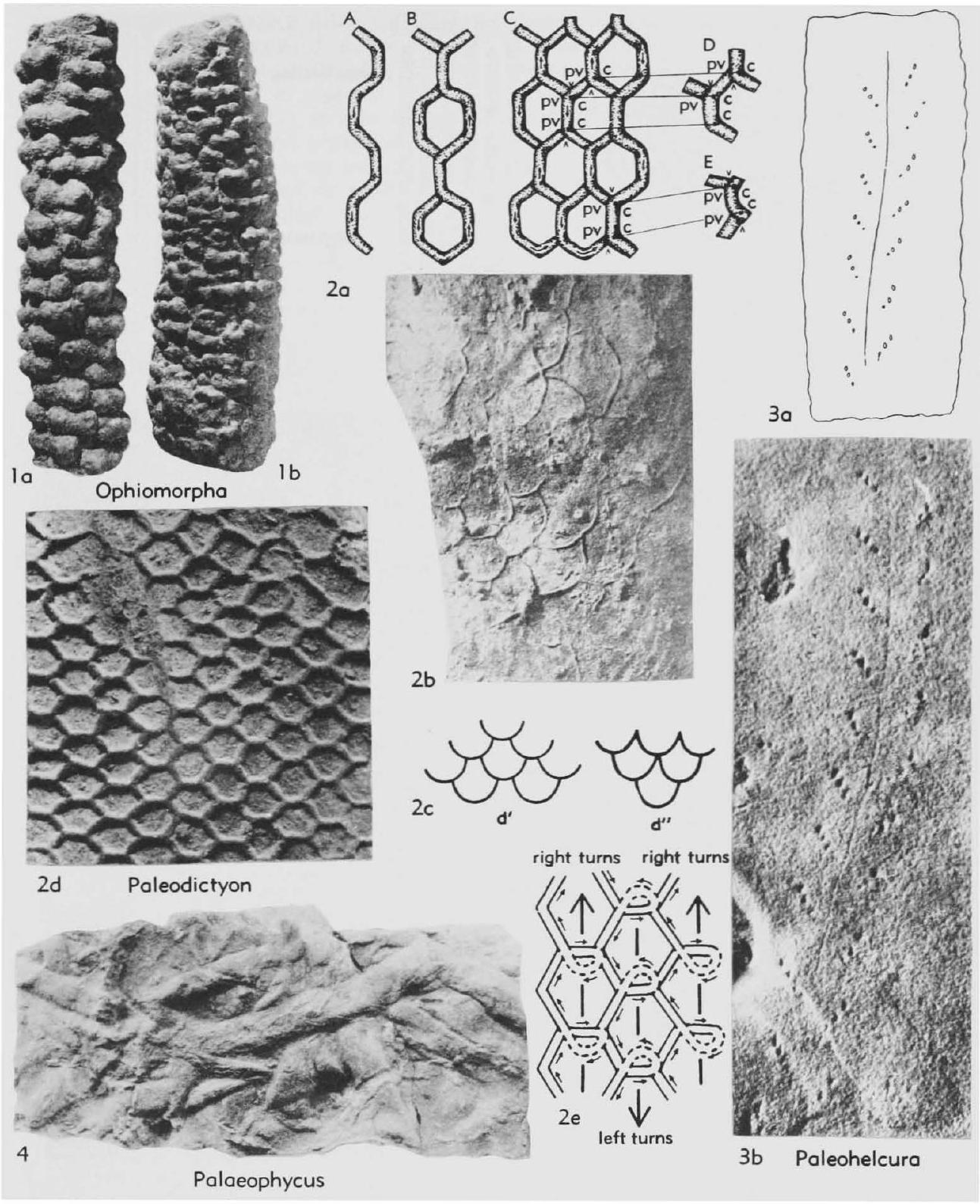
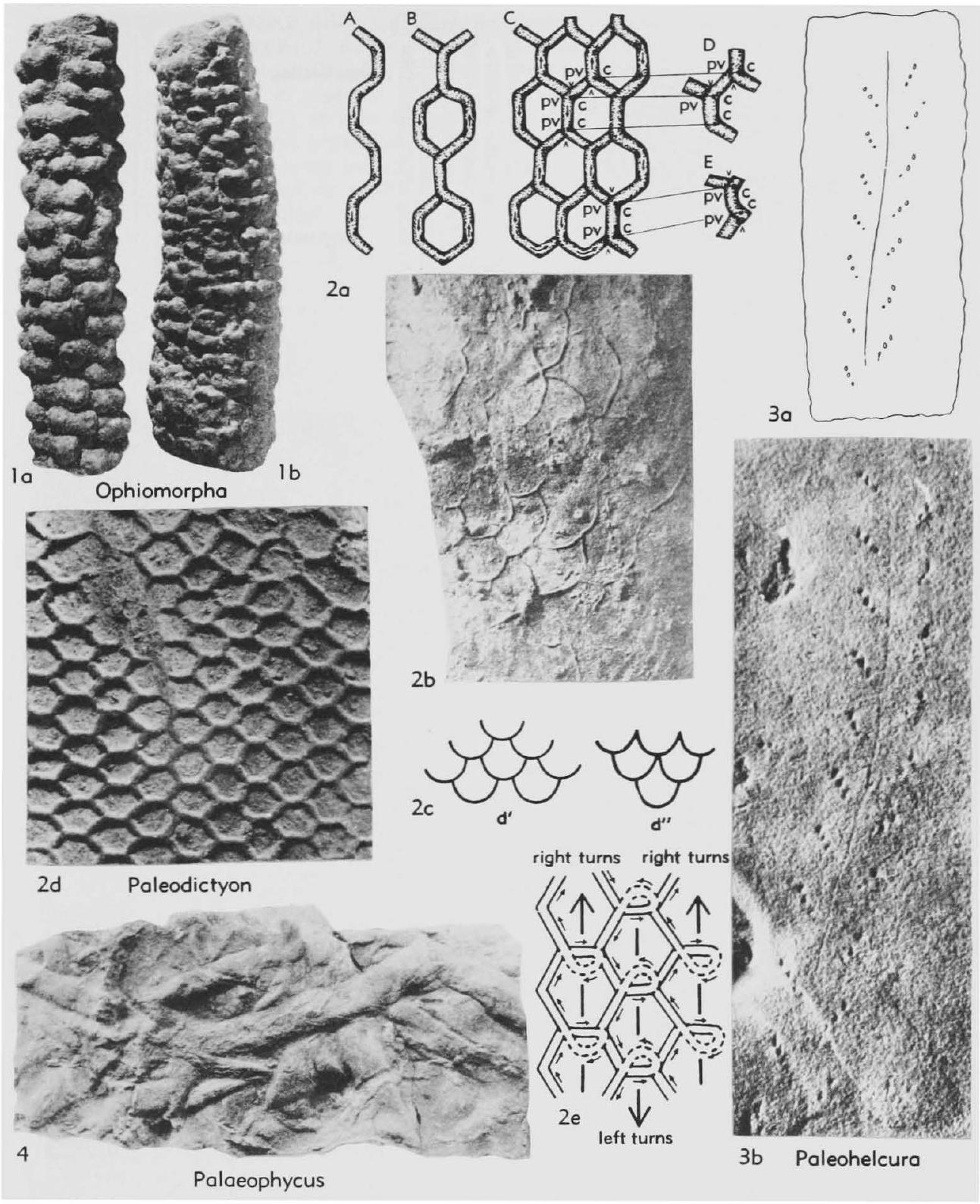 Fig. 54,4. *P. tubularis HALL, 1847, Ord.(Beekmantown beds), USA(Amsterdam, New York); X0.25 (Osgood, 1970).
Synonyms
Aulacophycos, Palaeospongia
Geographic Distribution
cosmop.
Age Range
Beginning Stage in Treatise Usage:
Precam. (but after evolution of animals)
Beginning International Stage:
Fortunian
Fraction Up In Beginning Stage:
0
Beginning Date:
538.8
Ending Stage in Treatise Usage:
Rec.
Ending International Stage:
Meghalayan
Fraction Up In Ending Stage:
100
Ending Date:
0
Description
Ichnogenus showing wide range of morphology; cylindrical or subcylindrical burrows, usually sinuous, oriented more or less obliquely to bedding; commonly unbranched, though may be branched occasionally; surface of walls smooth or rarely with faint longitudinal striae; up to about 20 cm. or more in length; 3 to 15 mm. in diameter; commonly intersecting one another. [Originally considered to be stems of "fucoids," interpreted by JAMES (1885) as trace fossil; belongs to repichnia of infaunal origin; pathways of various groups of errant animals; neither parts of constructed tubes as suggested by several authors nor stuffed burrows of sediment ingestors; " no one has studied the genus in detail" (OSGOOD, 1970, p. 375); very many "species" established from different environments; impossible to list all "species" erroneously placed in Palaeophyeus, e.g., P. kochi LUDWIG, 1869, p. 110 (=" Belorhaphe" kochi MICHELAU, 1955) and P. flexuosus JAMES, 1879 (inorganic, according to OSGOOD, 1970, p. 393); genus often compared with Planolites NICHOLSON, 1873, but in Palaeophyeus there is no distinct difference in lithology of the burrows and the host rock as in Planolites; for discussion see OSGOOD, 1970, p. 375; Spongillopsis GEINITZ, 1862, p. 132, established for Palaeophycus in lacustrine sediments (but S. reeurva FUCHE, 1906, p. 34, belongs to Rhizocorallium, perhaps also S. triadica FLICHE, 1906, p. 33).J
References
Museum or Author Information
Classification
Phylum:
Trace Fossils and Problematica
Class:
Trace Fossils
Formal Genus Name and Reference:
Palaeophycus HALL, 1847, p. 7
Type Species:
*P. tubularis, SD BASSLER, 1915, p. 939
Images
(Click to enlarge in a new window)
Fig. 54,4. *P. tubularis HALL, 1847, Ord.(Beekmantown beds), USA(Amsterdam, New York); X0.25 (Osgood, 1970).
Synonyms
Aulacophycos, Palaeospongia
Geographic Distribution
cosmop.
Age Range
Beginning Stage in Treatise Usage:
Precam. (but after evolution of animals)
Beginning International Stage:
Fortunian
Fraction Up In Beginning Stage:
0
Beginning Date:
538.8
Ending Stage in Treatise Usage:
Rec.
Ending International Stage:
Meghalayan
Fraction Up In Ending Stage:
100
Ending Date:
0
Description
Ichnogenus showing wide range of morphology; cylindrical or subcylindrical burrows, usually sinuous, oriented more or less obliquely to bedding; commonly unbranched, though may be branched occasionally; surface of walls smooth or rarely with faint longitudinal striae; up to about 20 cm. or more in length; 3 to 15 mm. in diameter; commonly intersecting one another. [Originally considered to be stems of "fucoids," interpreted by JAMES (1885) as trace fossil; belongs to repichnia of infaunal origin; pathways of various groups of errant animals; neither parts of constructed tubes as suggested by several authors nor stuffed burrows of sediment ingestors; " no one has studied the genus in detail" (OSGOOD, 1970, p. 375); very many "species" established from different environments; impossible to list all "species" erroneously placed in Palaeophyeus, e.g., P. kochi LUDWIG, 1869, p. 110 (=" Belorhaphe" kochi MICHELAU, 1955) and P. flexuosus JAMES, 1879 (inorganic, according to OSGOOD, 1970, p. 393); genus often compared with Planolites NICHOLSON, 1873, but in Palaeophyeus there is no distinct difference in lithology of the burrows and the host rock as in Planolites; for discussion see OSGOOD, 1970, p. 375; Spongillopsis GEINITZ, 1862, p. 132, established for Palaeophycus in lacustrine sediments (but S. reeurva FUCHE, 1906, p. 34, belongs to Rhizocorallium, perhaps also S. triadica FLICHE, 1906, p. 33).J