
Welcome to the Tracefossils subsite on Invertebrate Paleontology!
Please enter a genera name to retrieve more information.
Scolicia
Classification
Phylum:
Trace Fossils and Problematica
Class:
Trace Fossils
Formal Genus Name and Reference:
Scolicia de QUATREFAGES, 1849, p. 265
Type Species:
*S. prisca, M
Images
(Click to enlarge in a new window)
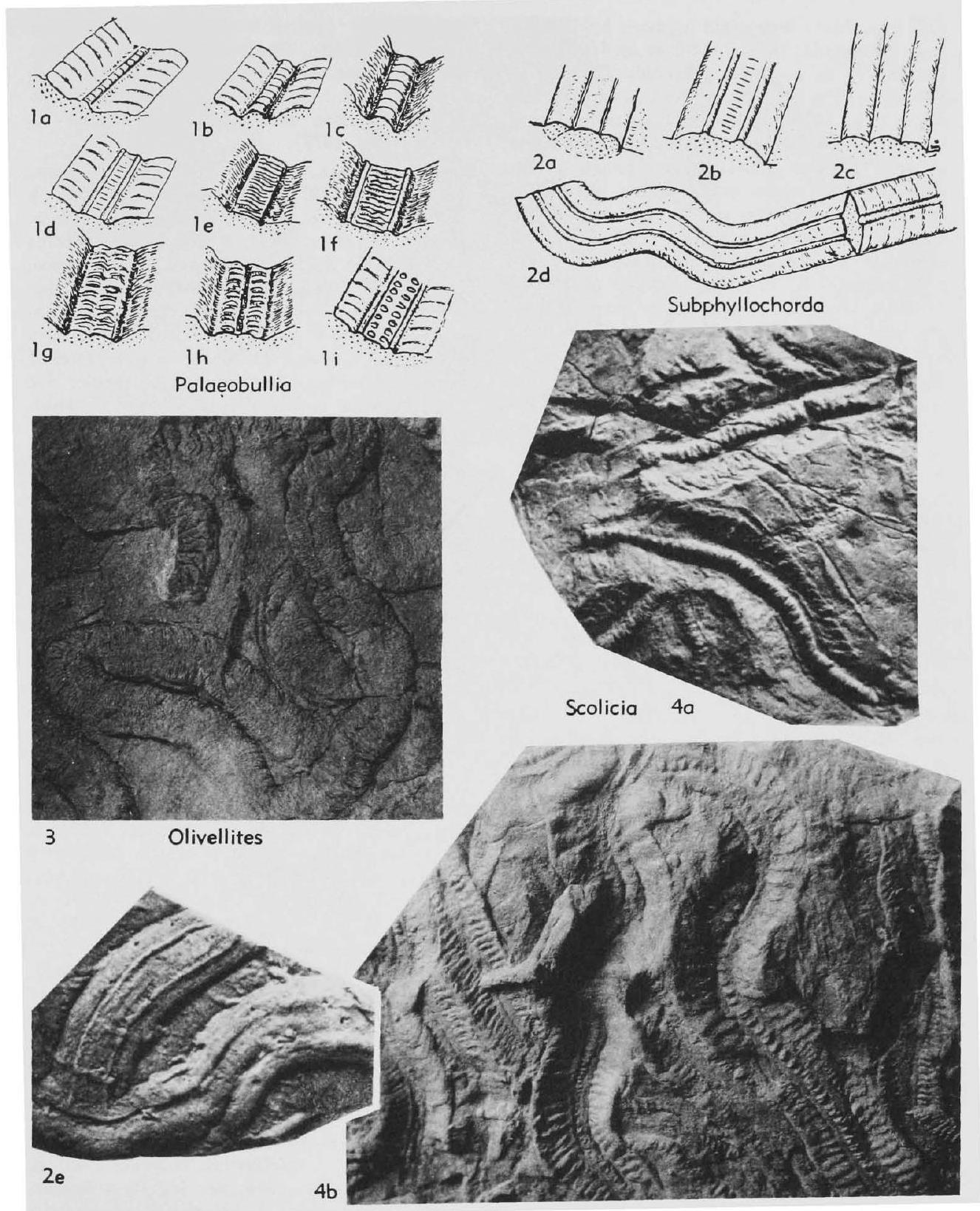 Fig. 66,1a-i. Palaeobullia; schem. drawing of different forms (Gotzinger & Becker, 1934). -- Fig. 66,2a-d. Subphyllochorda, schem. drawing of different forms (Gotzinger & Becker, 1934). -- Fig. 66,2e. Subphylloehorda striata, L.Eoc.(Beloveza Beds), Pol. (Lipnica Wielka); XOA (from Ksi:jzkiewicz, M., 1970, p. 291, in: Trace Fossils edited by T.P. Crimes & J.C. Harper, Gool. Jour. Spec. Issue 3, Seel House Press, Liverpool). -- Fig. 66,3. *Olivellites plummeri FENTON & FENTON, Penn. (Cisco F.), Texas; XOA8 (Fenton & Fenton, 1937b). -- Fig. 66,4. *S. prisea, 4a, 10w.Eoc. (Beloveza Beds), Pol.(Zubrzyca Gorna); X0.4 (from Ksi:jzkiewicz, M, 1970, p. 291, in: Trace Fossils edited by T.P. Crimes & J.C. Harper, Geol. Jour. Spec. Issue 3, Seel House Press, Liverpool); 4b, Eoc.(flysch), Aus., Italy; X0.4 (Seilacher, 1955)
Synonyms
Nemertilites, Nereiserpula, Psammiehnites, ?Phylloehorda, ?Bolonia, Seolithia, Palaeobullia, Subphylloehorda, Olivellites, Paleobulla
Geographic Distribution
cosmop.
Age Range
Beginning Stage in Treatise Usage:
Cam.
Beginning International Stage:
Fortunian
Fraction Up In Beginning Stage:
0
Beginning Date:
538.8
Ending Stage in Treatise Usage:
Tert.
Ending International Stage:
Gelasian
Fraction Up In Ending Stage:
100
Ending Date:
1.81
Description
Horizontal bilaterally symmetrical gastropod trails of great variability, long, bandlike, morphology depending on their origin as surface trails or internal trails; varied sculpture caused by different methods of burrowing, creeping, and removing sediment; up to about 4 cm wide, two main types: 1) type species (Scolicia s. str. = "group" Palaeobullia Götzinger & Becker, 1932) representing a "true trail" as surface trail of negative epirelief, consisting of variably shaped median axis, ribbonlike or ridgelike, ribbed, lateral parts transversely striated (the striae slanting backward from the midline) or of "gill-like" structure, width larger than or equal to median axis; type species briefly described by DE QUATREFAGES represents this type; 2) internal trails as sole trails, varied full relief burrows ("group" Subphyllochorda Götzinger & Becker, 1932), bandlike, trifid, with varied longitudinal markings, on both sides of the median ribbon characteristic narrow carinate ridges common; both of these types occasionally traceable over great distances. [Originally interpreted by DE QUATREFAGES as long annelid about 2 m. long; now regarded as creeping or feeding trail (or both) of burrowing gastropods; of wide facies range (Nereites and Cruziana facies); large bedding planes of European flysch deposits furrowed by coundess trails of Palaeobullia type; nomenclatural treatment of these variable trails difficult (e.g., KSIAZKIEWICZ, 1970, p. 289, used Seolicia only for the Palaeobullia type, and retained Subphylloehorda GOTZINGER & BECKER); for detailed discussion of Seolicia see GOTZINGER & BECKER (1932, p. 377-384; 1934, p. 82-84); AZPEITIA MOROS (1933, p. 9-17); ABEL (1935, p. 219-237); SEILACHER (1955, p. 373-376)].
References
Museum or Author Information
Classification
Phylum:
Trace Fossils and Problematica
Class:
Trace Fossils
Formal Genus Name and Reference:
Scolicia de QUATREFAGES, 1849, p. 265
Type Species:
*S. prisca, M
Images
(Click to enlarge in a new window)
Fig. 66,1a-i. Palaeobullia; schem. drawing of different forms (Gotzinger & Becker, 1934). -- Fig. 66,2a-d. Subphyllochorda, schem. drawing of different forms (Gotzinger & Becker, 1934). -- Fig. 66,2e. Subphylloehorda striata, L.Eoc.(Beloveza Beds), Pol. (Lipnica Wielka); XOA (from Ksi:jzkiewicz, M., 1970, p. 291, in: Trace Fossils edited by T.P. Crimes & J.C. Harper, Gool. Jour. Spec. Issue 3, Seel House Press, Liverpool). -- Fig. 66,3. *Olivellites plummeri FENTON & FENTON, Penn. (Cisco F.), Texas; XOA8 (Fenton & Fenton, 1937b). -- Fig. 66,4. *S. prisea, 4a, 10w.Eoc. (Beloveza Beds), Pol.(Zubrzyca Gorna); X0.4 (from Ksi:jzkiewicz, M, 1970, p. 291, in: Trace Fossils edited by T.P. Crimes & J.C. Harper, Geol. Jour. Spec. Issue 3, Seel House Press, Liverpool); 4b, Eoc.(flysch), Aus., Italy; X0.4 (Seilacher, 1955)
Synonyms
Nemertilites, Nereiserpula, Psammiehnites, ?Phylloehorda, ?Bolonia, Seolithia, Palaeobullia, Subphylloehorda, Olivellites, Paleobulla
Geographic Distribution
cosmop.
Age Range
Beginning Stage in Treatise Usage:
Cam.
Beginning International Stage:
Fortunian
Fraction Up In Beginning Stage:
0
Beginning Date:
538.8
Ending Stage in Treatise Usage:
Tert.
Ending International Stage:
Gelasian
Fraction Up In Ending Stage:
100
Ending Date:
1.81
Description
Horizontal bilaterally symmetrical gastropod trails of great variability, long, bandlike, morphology depending on their origin as surface trails or internal trails; varied sculpture caused by different methods of burrowing, creeping, and removing sediment; up to about 4 cm wide, two main types: 1) type species (Scolicia s. str. = "group" Palaeobullia Götzinger & Becker, 1932) representing a "true trail" as surface trail of negative epirelief, consisting of variably shaped median axis, ribbonlike or ridgelike, ribbed, lateral parts transversely striated (the striae slanting backward from the midline) or of "gill-like" structure, width larger than or equal to median axis; type species briefly described by DE QUATREFAGES represents this type; 2) internal trails as sole trails, varied full relief burrows ("group" Subphyllochorda Götzinger & Becker, 1932), bandlike, trifid, with varied longitudinal markings, on both sides of the median ribbon characteristic narrow carinate ridges common; both of these types occasionally traceable over great distances. [Originally interpreted by DE QUATREFAGES as long annelid about 2 m. long; now regarded as creeping or feeding trail (or both) of burrowing gastropods; of wide facies range (Nereites and Cruziana facies); large bedding planes of European flysch deposits furrowed by coundess trails of Palaeobullia type; nomenclatural treatment of these variable trails difficult (e.g., KSIAZKIEWICZ, 1970, p. 289, used Seolicia only for the Palaeobullia type, and retained Subphylloehorda GOTZINGER & BECKER); for detailed discussion of Seolicia see GOTZINGER & BECKER (1932, p. 377-384; 1934, p. 82-84); AZPEITIA MOROS (1933, p. 9-17); ABEL (1935, p. 219-237); SEILACHER (1955, p. 373-376)].