
Welcome to the Tracefossils subsite on Invertebrate Paleontology!
Please enter a genera name to retrieve more information.
Teichichnus
Classification
Phylum:
Trace Fossils and Problematica
Class:
Trace Fossils
Formal Genus Name and Reference:
Teichichnus SEILACHER, 1955, p. 378
Type Species:
*T. rectus, M
Images
(Click to enlarge in a new window)
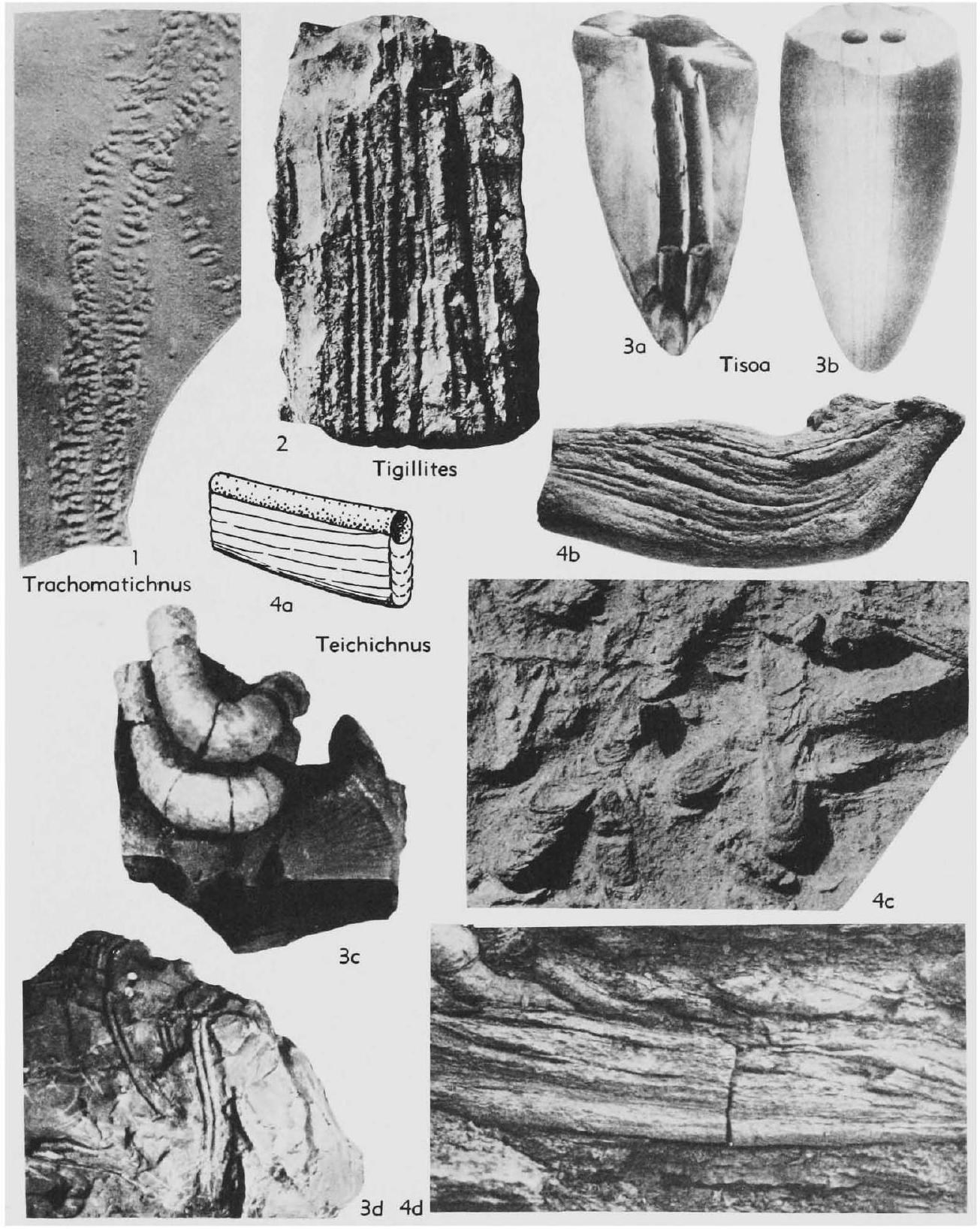 Fig. 71,4a,c. *T. rectus, L.Cam. (Kusak F.), Pak.(Salt Range), 4a, model, X0.4, 4c, X0.7 (Seilacher, 1955). -- Fig. 71,4b. T. sp., Cam. (Tapeats Ss.), Ariz. (Grand Canyon), X0.7 (Seilacher, 1956). -- Fig. 71,4d. Large teichichnian burrow, M.Cam., Swed. (Äleklinta, Öland), X0.3 (Martinsson, 1965)
Synonyms
Geographic Distribution
Cam., Eu.(Nor.-Swed.-Spain)-N.Am.(USA,Ariz.)-Asia(Pak.), Ord., Eu.(Ger.-Eng.)-N.Am.(Can.)-Asia (Iraq), U.Dev., Eu. (Eng), L.Carb., Eu.(Scot.-USSR), M.Trias., Eu. (Ger.), Jur., Eu.(France-Ger.-Swed.)-Greenl., U.Cret., USA(Kans.-Utah), Tert., Eu.(Eng.-Belg.)
Age Range
Beginning Stage in Treatise Usage:
Cam.
Beginning International Stage:
Fortunian
Fraction Up In Beginning Stage:
0
Beginning Date:
538.8
Ending Stage in Treatise Usage:
Tert.
Ending International Stage:
Gelasian
Fraction Up In Ending Stage:
100
Ending Date:
1.81
Description
Spreiten-bauten formed by series of long horizontal burrows stacked vertical to bedding; resembling stacked flat U-shaped roof gutters with pipe at top; wall-shaped laminar body straight or slightly sinuous; generally not branching; commonly retrusive built but can also be protrusive, up to about 50 cm long (in M.Cam. of Öland up to 135 cm), about 10 cm or more in height. [Endogenic burrows, belonging to fodiniehnia; producer unknown, but, due to the very long time range of this ichnogenus, certainly made by different groups of animals; comparable modern structures made by the Recent polychaete Nerds diversicolor (see SEILACHER, 1957, p. 203); MARTINSSON (1965, p. 216) explained Cambrian specimens as combinations of retrusive and protrusive digging activity; transitional forms to Rhizocorallium (L.Carb., Scotland) were described by CHISHOLM (1970b); as shown by SELLWOOD (1970, p. 494), a limb of a vertically retrusive Rhizocorallium may be mistaken for Teichichnus; tunnels of Ophiomorpha have been observed to grade into Teichichnus-like structures (Eoc., N.Am., Miss.) (Hester & Pryor, 1972, p. 686); the relationships of Teichichnus to Phycodes were discussed by HANTZSCHEL & REINECK (1968, p. 26).]
References
Museum or Author Information
Classification
Phylum:
Trace Fossils and Problematica
Class:
Trace Fossils
Formal Genus Name and Reference:
Teichichnus SEILACHER, 1955, p. 378
Type Species:
*T. rectus, M
Images
(Click to enlarge in a new window)
Fig. 71,4a,c. *T. rectus, L.Cam. (Kusak F.), Pak.(Salt Range), 4a, model, X0.4, 4c, X0.7 (Seilacher, 1955). -- Fig. 71,4b. T. sp., Cam. (Tapeats Ss.), Ariz. (Grand Canyon), X0.7 (Seilacher, 1956). -- Fig. 71,4d. Large teichichnian burrow, M.Cam., Swed. (Äleklinta, Öland), X0.3 (Martinsson, 1965)
Synonyms
Geographic Distribution
Cam., Eu.(Nor.-Swed.-Spain)-N.Am.(USA,Ariz.)-Asia(Pak.), Ord., Eu.(Ger.-Eng.)-N.Am.(Can.)-Asia (Iraq), U.Dev., Eu. (Eng), L.Carb., Eu.(Scot.-USSR), M.Trias., Eu. (Ger.), Jur., Eu.(France-Ger.-Swed.)-Greenl., U.Cret., USA(Kans.-Utah), Tert., Eu.(Eng.-Belg.)
Age Range
Beginning Stage in Treatise Usage:
Cam.
Beginning International Stage:
Fortunian
Fraction Up In Beginning Stage:
0
Beginning Date:
538.8
Ending Stage in Treatise Usage:
Tert.
Ending International Stage:
Gelasian
Fraction Up In Ending Stage:
100
Ending Date:
1.81
Description
Spreiten-bauten formed by series of long horizontal burrows stacked vertical to bedding; resembling stacked flat U-shaped roof gutters with pipe at top; wall-shaped laminar body straight or slightly sinuous; generally not branching; commonly retrusive built but can also be protrusive, up to about 50 cm long (in M.Cam. of Öland up to 135 cm), about 10 cm or more in height. [Endogenic burrows, belonging to fodiniehnia; producer unknown, but, due to the very long time range of this ichnogenus, certainly made by different groups of animals; comparable modern structures made by the Recent polychaete Nerds diversicolor (see SEILACHER, 1957, p. 203); MARTINSSON (1965, p. 216) explained Cambrian specimens as combinations of retrusive and protrusive digging activity; transitional forms to Rhizocorallium (L.Carb., Scotland) were described by CHISHOLM (1970b); as shown by SELLWOOD (1970, p. 494), a limb of a vertically retrusive Rhizocorallium may be mistaken for Teichichnus; tunnels of Ophiomorpha have been observed to grade into Teichichnus-like structures (Eoc., N.Am., Miss.) (Hester & Pryor, 1972, p. 686); the relationships of Teichichnus to Phycodes were discussed by HANTZSCHEL & REINECK (1968, p. 26).]