
Welcome to the Tracefossils subsite on Invertebrate Paleontology!
Please enter a genera name to retrieve more information.
Thalassinoides
Classification
Phylum:
Trace Fossils and Problematica
Class:
Trace Fossils
Formal Genus Name and Reference:
Thalassinoides Ehrenberg, 1944, p. 358 (emend. KENNEDY, 1967, p. 132)
Type Species:
*T. callianassae, OD
Images
(Click to enlarge in a new window)
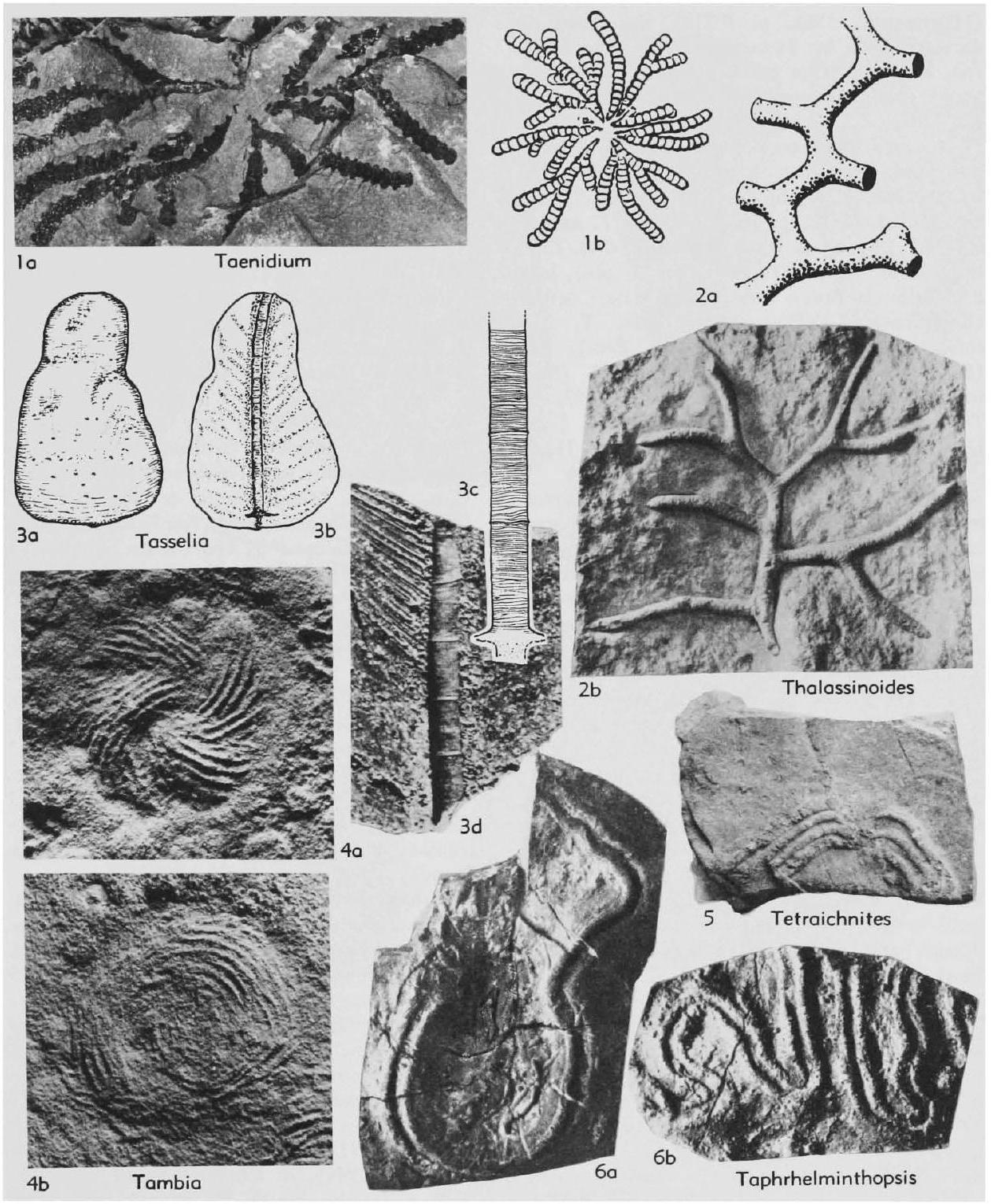 Fig. 70,2a. T. sp., Mio.(marine molasse), Switz.; ca. X0.07 (Seilacher, 1955). -- Fig. 70,2b. T. saxonicus (GEINI'rz), U.Cret.(up. Cenoman.), Ger.(Sax.) ; X0.08 (Muller, 1970b)
Synonyms
Geographic Distribution
Trias.-Tert., Eu.-Asia(Iraq)-Taiwan-VSA (Kans.-Vtah)-Australia (Vic.); L.lur., GreenI.-G.Brit.; L.Cret., VSA(N.Mex.-Texas); U. Cret.(Cenoman.), Eu.(PoI.
Age Range
Beginning Stage in Treatise Usage:
Trias.
Beginning International Stage:
Induan
Fraction Up In Beginning Stage:
0
Beginning Date:
251.9
Ending Stage in Treatise Usage:
Tert.
Ending International Stage:
Gelasian
Fraction Up In Ending Stage:
100
Ending Date:
1.81
Description
Cylindrical burrows forming 3-dimensional branching systems consisting of horizon tal networks connected to surface by more or less vertical shafts; burrows 1 to about 20 em. (typically 10-15 mm.) in diameter; regularly branching, Y-shaped bifurcations; in horizontal systems forming polygons; typical swellings at points of branching or elsewhere; rare transitional forms with tuberculate structure of Ophiomorpha have been described (MULLER, 1970b). [Formerly interpreted as algae or horny sponges (Ceratospongidae); undoubtedly feeding and dwelling burrows of crustaceans; sometimes associated with actual remains of callianassids (EHRENBERG, 1938; MERTIN, 1941, GLAESSNER, 1947, MULLER, 1970b), described with Glyphea crustacean inside burrow (SELLWOOD, 1971); Recent lebensspuren comparable to T. saxonicus described from modern burrows of caIlianassids; producers most likely living in sublittoral environment; burrows and burrow systems in hardgrounds more irregular (lacking widenings, branching) than those in soft chalk; for discussion of filling mechanism of such crustacean burrows (fill channels on their crests) see SEILACHER, 1968, p. 200.]
References
Museum or Author Information
Classification
Phylum:
Trace Fossils and Problematica
Class:
Trace Fossils
Formal Genus Name and Reference:
Thalassinoides Ehrenberg, 1944, p. 358 (emend. KENNEDY, 1967, p. 132)
Type Species:
*T. callianassae, OD
Images
(Click to enlarge in a new window)
Fig. 70,2a. T. sp., Mio.(marine molasse), Switz.; ca. X0.07 (Seilacher, 1955). -- Fig. 70,2b. T. saxonicus (GEINI'rz), U.Cret.(up. Cenoman.), Ger.(Sax.) ; X0.08 (Muller, 1970b)
Synonyms
Geographic Distribution
Trias.-Tert., Eu.-Asia(Iraq)-Taiwan-VSA (Kans.-Vtah)-Australia (Vic.); L.lur., GreenI.-G.Brit.; L.Cret., VSA(N.Mex.-Texas); U. Cret.(Cenoman.), Eu.(PoI.
Age Range
Beginning Stage in Treatise Usage:
Trias.
Beginning International Stage:
Induan
Fraction Up In Beginning Stage:
0
Beginning Date:
251.9
Ending Stage in Treatise Usage:
Tert.
Ending International Stage:
Gelasian
Fraction Up In Ending Stage:
100
Ending Date:
1.81
Description
Cylindrical burrows forming 3-dimensional branching systems consisting of horizon tal networks connected to surface by more or less vertical shafts; burrows 1 to about 20 em. (typically 10-15 mm.) in diameter; regularly branching, Y-shaped bifurcations; in horizontal systems forming polygons; typical swellings at points of branching or elsewhere; rare transitional forms with tuberculate structure of Ophiomorpha have been described (MULLER, 1970b). [Formerly interpreted as algae or horny sponges (Ceratospongidae); undoubtedly feeding and dwelling burrows of crustaceans; sometimes associated with actual remains of callianassids (EHRENBERG, 1938; MERTIN, 1941, GLAESSNER, 1947, MULLER, 1970b), described with Glyphea crustacean inside burrow (SELLWOOD, 1971); Recent lebensspuren comparable to T. saxonicus described from modern burrows of caIlianassids; producers most likely living in sublittoral environment; burrows and burrow systems in hardgrounds more irregular (lacking widenings, branching) than those in soft chalk; for discussion of filling mechanism of such crustacean burrows (fill channels on their crests) see SEILACHER, 1968, p. 200.]